Does desire really have to die in long-term relationships—or have we just accepted that myth as inevitable?
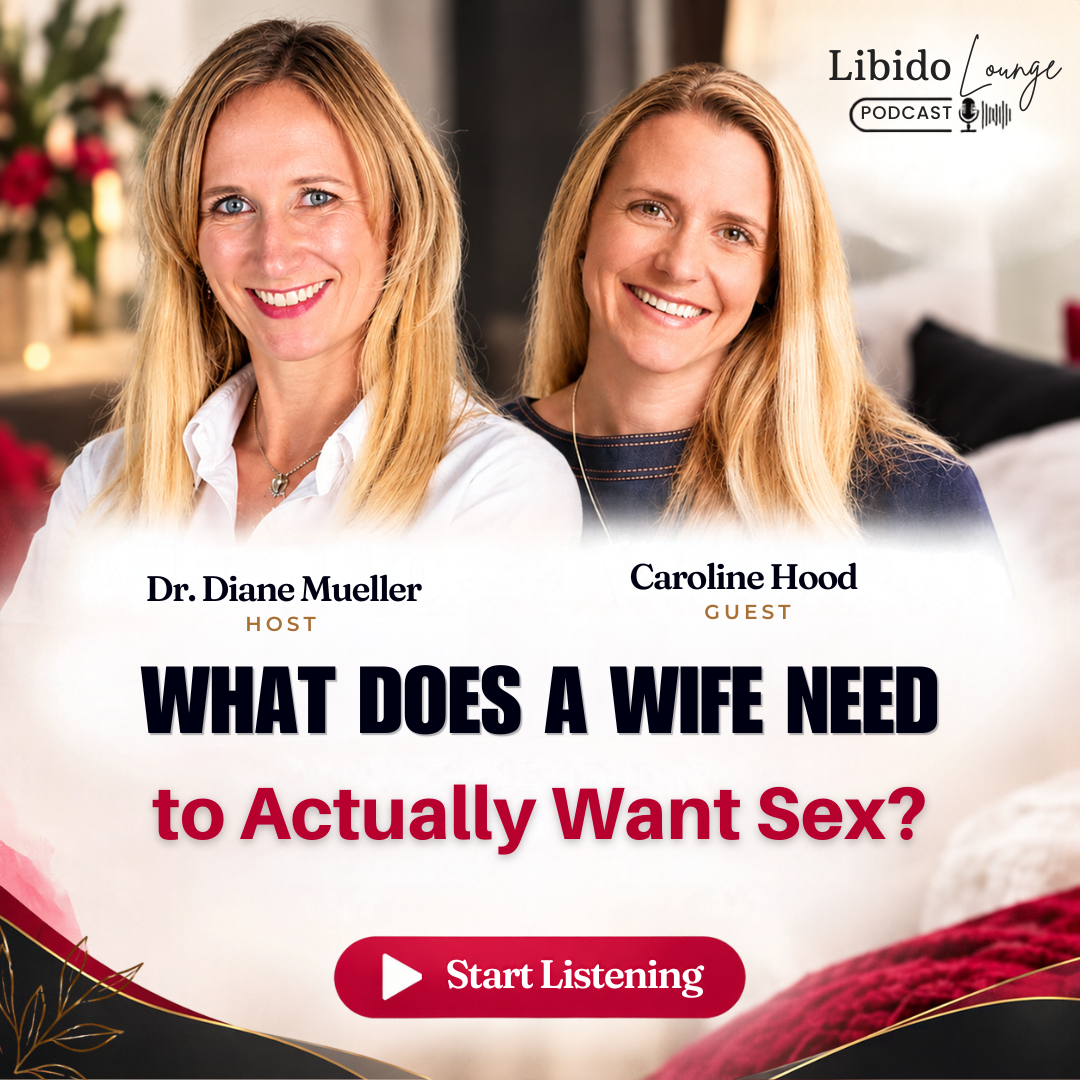
In this episode, Dr. Diane Mueller sits down with Caroline Hood to tear into the quiet traps that kill desire: obligatory sex that feels like scheduled maintenance, the cultural messaging that strips women of permission to want sex for themselves, and the false hierarchy that insists emotional intimacy must be perfect before physical intimacy can begin. They dig into why “sex begets sex” is more than a catchy title—how physical connection actually builds emotional closeness through oxytocin, pleasure, and presence—and why waiting for the perfect circumstances keeps so many couples stuck in disconnection. This conversation is raw about what’s at stake: the erosion of erotic aliveness, the shame that settles into midlife bedrooms, and the real possibility of reclaiming desire without pretending the logistics of life disappear.
You won’t want to miss this if you’re a woman who’s started treating sex like another chore, or a couple wondering whether the spark is simply gone for good.
About Caroline Hood
Caroline Hood is a sex and relationships writer, speaker, and consultant exploring the deeply human realities of sex, desire, intimacy, and long-term love. A licensed clinical social worker and certified sex therapist, she draws on more than 25 years of professional experience to combine candid storytelling, clinical insight, and cultural critique that challenge conventional wisdom about relationships and female desire.
Caroline is the author of Sex Begets Sex and writes the newsletter Desire in Real Life, where she explores sexual agency, intimacy, and the cultural narratives that shape our relationships. She holds a bachelor’s degree in Psychology from Columbia University, a Master of Social Work from the University of Southern California, and an Executive Leadership Certificate from Harvard University.
Originally from the United States and now based in Sydney, Australia, Caroline lives with her husband, their three children, and their two rescue dogs.
Website: www.desireinreallife.com
IG: https://www.instagram.com/desireinreallife/
Substack: https://substack.com/@desireinreallife
Table of Contents
Does Desire Fade in Long-Term Relationships Part 1
Dr. Diane: Welcome back to the Libido Lounge, everybody. I’m your host, Dr. Diane Mueller and I am so excited to introduce you to Caroline Hood who’s a sex and relationship writer, speaker, and consultant. She’s the author of Sex Begets Sex and writes the newsletter Desire in Real Life. We’re going to dispel some myths with Caroline. So, one of the myths we’re going to dispel is that desire naturally fades in long-term relationships. This comes up, I know, a ton on this show. And oftentimes, I think we just kind of accept that that new relationship energy that is so fun just fades away and we never get to have that kind of desire again. And we’re going to break this down. We’re going to talk about why so many couples are just waiting for the perfect circumstances to begin to prioritize intimacy and how to break that and so much more. So, Caroline, it’s so great to have you. Welcome to the lounge.
Caroline: Oh my gosh, thank you for having me. Yeah, I’m ready to do some myth busting. Should be great.
Dr. Diane: That’s great. Well, let’s dive right in. So, I want to talk about this whole thing around desire fading in long-term relationships because as I said in the intro, it’s what so many people believe. So, in your experience, is this even true?
Caroline: No, I think it’s common. So, I think it’s common and I think it’s pretty normal, but it’s not inevitable. And that’s where I think people get tripped up. They see it just sort of everywhere in their friends, in media and books and sitcoms and all of that and they think okay well like that desire and that high libido is for a new relationship or for my 20s or for some other time and no I don’t think it’s true. I think it requires intention or a different mindset and we can talk through that but I don’t think it’s inevitable.
Dr. Diane: Yeah, you’re differentiating something that I love to differentiate in my work which is common and normal. And just because something is common first of all doesn’t mean it’s normal and even if it does doesn’t mean it has to happen to you. So I think oftentimes we see like you’re saying it’s like oh my friends my lovers people from your past had this experience and all of a sudden we just think that that means that we are a victim of our circumstances. But what you’re saying is we can do something to prevent that. Right. And what are those things?
Caroline: Yeah, I think absolutely. You know, we and I think kind of highlighting and targeting women primarily, but couples generally, we fall into these tropes where we just think, oh, we’re busy or we had kids or we’re perimenopausal or they’re sort of rational excuses, I think. So, I don’t want anyone to think, oh my gosh, I’m crazy or I’m lazy or, you know, this is my fault. It’s not any individual person’s fault. I think it’s really hard to push against this messaging that tells us that desire has to fade, but it’s very possible. And that’s where I think we can look at, you know, what does it actually mean to create connection in a long-term relationship? What does it actually mean to maintain that, you know, quote unquote spice and that conversation and keep flirting alive and keep desire really fresh when you are co-workers in some senses? You are co-parents, right? Like you have to be both. You have to be a really effective logistical partner and you also have to be lovers. And sometimes I think people fall into only paying attention to one and they think that that hot sex life is like a reward if everything else is done or it’s the cherry on top or it’s if there’s time. And that’s where I wish couples would say no no like we’re going to keep this a foundation of our relationship and not this extra thing that maybe we can do if everything else is organized.
Dr. Diane: I think we’ve come up with this myth in society. I like and I know there’s like the reason the common things around like well you see your friends doing it you’re you know you maybe you see it on social on TV and media where the only thing that typically is portrayed around relationships is that hot heavy new relationship energy. You know we’re not watching movies of like long-term couples and they’ve been together for 20 years and they’re having you know hot sex. But beyond that, you know, thinking about just the way that our subconscious gets programmed around this, where else do you think this is coming from?
Permission to Want Sex as a Woman
Caroline: Yeah, I think that there’s a lot of sort of I go back to a lot of feminist theory on some of this, which is that particularly for women, particularly mothers, their desire, they don’t actually have permission to have desire. They don’t actually have permission to embrace their own needs, their own pleasure, their own wants. They’re supposed to be completely selfless. And I don’t think it’s just moms. I think it’s kind of women of a certain age, quote unquote, right? Or it’s perimenopausal or sort of postprime. All of these air quotes, but it’s this idea that I think women are meant to be submissive. We are meant to, you know, we center male pleasure. We, the royal we. And so this idea that desire is anything that belongs to women really, I think, goes against the grain of this messaging we’re all swimming in. And so it’s really hard for women to say, “Hang on, wait a second.” Like, “This is mine. I’m a sexual being. I get to be a sexual agent. I get to have pleasure. I get to prioritize that.” That’s just not the sort of ecosystem that we’re bred in. And I think we often don’t even recognize that. And so we can sort of skip that permission piece and jump straight to some more sort of tactical maneuvers like if we just schedule sex or oh if we just masturbate more and those are great. I’m all for all of those things but I think if we don’t dig into like as you said like where is this actually coming from? Like where are these messages? And I think we sort of miss the mindset shift that we all get to take.
Dr. Diane: Yeah. I definitely think you know including the men too I do think we are in a scenario where there’s just lack of education for women and men both on desire and I think there’s still this belief that men and women’s desire map their arousal cycle is actually largely the same you know and and even though I think like talking to women and and telling women like oh yeah it takes longer for your arousal to kick on like I know for me until I started studying all of this I thought there was something wrong with me that I couldn’t say get aroused at the same timeline by male partners, right? And then I think there’s the men that then they think there’s something wrong with them if they’re not bringing the woman to arousal quick enough, right? Yeah. and then nobody’s talking about it and nobody’s so yeah there’s like the spontaneous and responsive desire and those different pathways that I think at least the sort of circles of the internet that I swim in it seems to be a growing knowledge base for particularly women going oh okay this responsive desire like I need to get myself into a position and where the desire can sort of click on as opposed to just sort of being horny at a moment’s notice which which isn’t all male or all female, right? But there’s there sort of general ways in which that distributes. But but I think you’re right. There’s we are not educated and we don’t have the vocabulary and and we certainly haven’t been told to talk to your partner, talk about what’s going on, talk about what you like, what you don’t, what you’re interested in, that you’re a little nervous, you’re confused. I mean, we don’t support couples in that myth of like, oh, if it’s true love, it’ll just magically you’ll just magically align. I mean, it’s such a setup. It really it really does such a disservice to couples.
Obligatory Sex in a Relationship
Dr. Diane: So, I want to talk about this this idea of like what motivates people to have sex because I feel like there’s so much pressure, right? there’s like a lot of pressure around sex on you know within the couple and oftentimes if usually like the woman typically doesn’t have this as strong of a desire as the man it can I definitely seen it go the other way but oftentimes I feel like that the reason is along the lines of obligation like okay if like the one with less desire well you don’t want to be a bad partner you don’t want to be a bad lover that you know that sort of thing is the primary motivator as far as people actually being intimate when they’re not in the mood. So, how do we get around this in your opinion? Like, how do we get around this and find other reasons that is not just like the obligatory, you know, motivational factor?
Caroline: Yeah, I mean, I think you’re right. That’s it is common. And I think, you know, sex turns into in a lot of couples this sort of like oil change or something. It’s like, okay, this is our scheduled maintenance and we have to do it and potentially one partner feels more obligated than the other. And and you can look at that as a little bit of a really lovely like I know this is important for my partner. I care for them. I love them. I think that’s a nice sentiment, but but obligatory sex is not sexy. And and I also don’t think you know the person sort of on the receiving end of that obligatory sex. That’s that doesn’t feel great for them. Sure, they might be able to have an orgasm, but that’s not real fulfilling sex. So I do think it comes back to in this sense is the sex you’re having pleasurable? You get to the pleasure. So if it’s just obligatory, then I think to myself, well then what about that sex is not actually enjoyable? And are you having the type of sex you like? Are you communicating about that? Are you having orgasm? Is this just about penetrative sex? You know, I think is it physically and or sort of emotionally enjoyable to you? Do you get benefit from it or do you feel like it’s just a just a maintenance? You know, that’s what I would dig into there because I do think it’s really common that people have this obligatory nature and and it can be I’m sure you see this that that it can almost start as sort of this nice thing and it can turn really toxic really quickly.
Dr. Diane: I just want to take a quick break to say one of the number one things that leads to a lack or just a slowing of passion in the relationship is thinking that our partner’s body and mind and spirit is going to be the same today as tomorrow. So, one of the things that happens for so many bodies, especially for female bodies, is that with time, the pleasure needs change. And we get into those sexual scripts and those habits of doing the same thing over and over and over again, not always realizing that our pleasure body is wanting something else. This creates a lack of passion, a desire, a lack of orgasm, and is one of the reasons why bedrooms can start to get quieter. I talk about how to fix this and so much more walking you through a step-by-step guide for an entire year if you want on how to improve your pleasure life. Start with a free trial, stay for a month, stay for the year, make it yours. You’ll see all of this and more and how to get started in the show notes below this video. I hope you will join me in my hot monogamy society. Now, let’s get back to our episode.
Sex Begets Sex
Dr. Diane: So, this is a really lead to my next question, which is in your book, Sex Begets Sex. Like, one of the things I get from your title at least is that there’s this element of when you’re having sex, then there’s a desire to like say have more in the future, right? So it’s like by the act we increase our desire. So my question is this like where is the line in your opinion between hey start before you’re actually feeling ready and then desire will follow so that and hey overwriting your own no and listening to your body like how do we how do we like peel that apart?
Caroline: Yeah, I think that’s a really good question and I think there’s sort of some basic like if there’s abuse, if there’s trauma, if there’s that stuff, then then that’s that’s a separate conversation, right? So there’s the assumption that this is a caring, adaptive, healthy relationship with sex, we get sex, as you said. Yes. The idea is that there is this sort of positive or virtuous feedback loop. So if you’re having sex, the more you have, the idea is that the more you have, the more fun it is, right? Sex in part is a little bit of a skill, right? It your own knowing your own body, knowing your partner’s body. So the more you have, the better you get at it, the more pleasurable it is and therefore the more you go, oh yeah, that was fun. Like let’s do that again. So if you can get yourself into that positive feedback loop, it begets itself, right? So what I think but if people are sort of stuck in this like where do I even start? Because once it feels good, then you then you don’t have to over you never want to override a no. That’s never that’s never positive. Your body will never get there. There’s a very different piece from responsive desire to overriding that no. And that’s where I think it’s about you build in that communication. You build in ensure that you have trust. ensure that you have really open dialogue about what’s happening both within your sex life as well as across the different domains of your partnership. And then I also think there’s a really important piece around this also a feedback loop where emotional intimacy can help drive that physical desire, right? but also physical intimacy and the release of oxytocin and the connection that you receive and the stress reduction and those other components of physical intimacy, they can also support that emotional intimacy. And I think that can be a really good buffer against many of the stresses you might encounter in a long-term partnership, whether it’s parenting or finances or health. And so that there too becomes a feedback loop which I think helps to fortify or or sort of solidify that couple as a couple as opposed to just co-parents or co-workers. So there’s a lot there’s a lot to it and and your sort of question like finding that line. I mean, that line is going to look different for everybody. And that’s that’s I think I mean, it really just goes back. There’s communication, there’s self-awareness, there’s being vulnerable with your partner. I mean, there’s so much about sex that that happens outside of the bedroom, right? That happens in those other moments and that you build that ability to be fully present and vulnerable in a sexual encounter.
Physical Intimacy Builds Emotional Intimacy
Dr. Diane: Yeah. My next question for you is about emotional and physical intimacy. And so I’m going to ask this, but before I get into the misunderstanding I think between emotional and physical intimacy, I just want to take a moment to mention one of my sponsors because one of the things that I find oftentimes is, you know, with this concept of sex begets sex and your book, I often talk in my work about pleasure begets pleasure. So I your book title so much, right? Because yeah, we even see that like that oxytocin when we increase oxytocin in the brain through pleasure, the body actually says it kicks out the signal to release more oxytocin. So there’s a real scientific thing happening there. And then of course like what if there’s performance challenges? If there’s vaginal dryness, if there’s lack of desire, if the man’s having, you know, challenges performances there there’s like real there’s a real thing that can happen there, right? And so one of my favorite tools out there are the penis pumps and the lady pumps by Dr. Joel Kaplan. So these are absolutely amazing. their science and physics coming together where we have like this suction and we have all these different sizes and there’s more right for men and then women have for their vulva they have these two different sizes as well as well as like a clitoral one and these devices just sit with this pump on them and that provide this vacuuming and this vacuum suction allows for so much blood flow into the penis and into the vagina and just allows for hardness. It allows for actual size changes for men both in length and girth that have been shown to actually lead to permanent changes. Females vaginal dryness, more pleasure, on and on and on and on. So, you know, pleasure begets pleasure. So, this is a really great starting point for couples. And you can find coupon codes and and links for that in the show notes. But my question for you on this is okay so with physical and emotional intimacy oftentimes we’re taught that physical intimacy happens when emotional intimacy is strong right this is what a lot of therapists will teach but you my question is when when we’re thinking about this isn’t physical intimacy also one of the ways we create emotional intimacy right so there’s this like this cycle so how do we get out of this where do we start
Caroline: Yes it’s it’s really frustrating And there seems to be this sort of hierarchy that I’m seeing or this value this sort of moral value that’s like emotional intimacy must must precede physical intimacy and or other sort of facets which is like if there’s any you know 100% of the connection between the two partners must be fully healed fully resolved fully nitpick your word and only then shall you have good physical intimacy. And I think I mean I I’m pretty sure a lot of people can look back on those sex lives and go, “Oh, right.” Like I had really hot sex with that guy who was a total jerk. Like so so how does that you can’t confirm your hypothesis if if you have experiences like that where you go okay actually I have been able to have really really positive physical intimacy with someone where I had no emotional intimacy whatsoever. So what’s that about? So it’s more complicated. But I think we have to really look at the fact that that there is something about, you know, you’re talking about pleasure. There is something about pleasure that that is allowed when there is freedom and there is there is you’re able to kind of shut your brain off. You’re able to it’s not fraught. And sometimes those one night stands or whatever you want to call them, you’re not going to see the person the next day. You don’t care. So there is a freedom there which is a little bit different than somebody you love and you want to build a family with and you want to spend your life with that it it means more. So, so I think this I there’s so many reasons why we’re why this idea that the emotional intimacy must be fully fixed and until that is again it sets up couples because as you just said the physical can drive the emotional and if you’re always waiting for the emotional to be perfect you’re you’re not allowing the physical to sort of play its part in the healing in the in the intimacy in the affection and you’re not you’re not using it and enjoying it for its full capacity I Again, I think this is where it’s it’s setting couples up and we’ve we’ve just gone too extreme. Like, I think it’s great that we’ve recognized that emotional intimacy is super important. And it’s great that we’re not telling women, hey, just just say yes no matter how you feel, even if your even if your husband or your boyfriend is a jerk. Like, okay, good. But but that doesn’t mean that we don’t find other ways to connect and grow our connection through the physical.
Dr. Diane: Yeah, I love that. And that’s a perfect way of wrapping up and then letting everybody know we’re going to continue our conversation in part two. In part two, when we have you back next week, I want to talk a lot about more what we do about this, right? What do we do more specifically of how we get out of this cycle of, you know, physical intimacy, helps with emotions, but emotions help with physical intimacy. And where do we start? And I want to talk about also this this idea on spontaneity because this is another thing that I think is just a myth that we see in the sexual wellness world around around is spontaneity good, is spontaneity bad, is scheduling good, is scheduling bad, what is going to really sustain desire over time. So, we’re going to talk about that next time. So, everybody make sure you subscribe so you don’t miss out on that. And then I want everybody to know how to get a hold of you, how to get a hold of some of your resources as well as your book. So can you tell us a little bit about that?
Caroline: Yeah, sure. All of my handles are the same. So desireinreal life is where you’ll find all my work. My website desireinrealife.com desireinrealife on Instagram and then Substack is a really great place to find all my reading and resources at Desire in Real Life. Easy.
Dr. Diane: Amazing. So we will put all those links in the show notes for you guys. I hope you will go check out Caroline’s book and then again make sure you subscribe so you get next week’s information. We’re going to talk more action steps, strategy, and more. And of course, the penis and lady pumps. You’ll find those in the show notes as well with coupon codes. Thank you everybody for tuning in to another episode of the lounge. And thank you Caroline for being here with me today.
Caroline: Thank you. We will see you all next week.
Dr. Diane: Thank you for listening to the Libido Lounge. Please don’t keep me a secret. Please share this with your friends. You can find me on YouTube, on Instagram, and check out our Modern Libido Club for so much more!
Does Desire Fade in Long-Term Relationships Part 2
Dr. Diane: Hey everyone, welcome back to another episode of the Libido Lounge. I’m your host, Dr. Diane, and I’m so excited to welcome back for another week, Caroline Hood. If you missed our episode last week, I strongly recommend you go back. We’ll put the link in the show notes for part one of this conversation. And we talked a lot in that episode around desire fading in long-term relationships and what to do about that, as well as if this is really even true, right? We talked about how a lot of these things that happen are common and so we accept them as normal, but really broke down the myth of accepting that just because it’s common and we see our friends and family members going through it, it doesn’t mean it has to be our story, too. Now, today I wanted to bring Caroline back on so that we could talk more around solutions. So, we’re going to talk today around solutions for getting your intimacy back, bringing back spontaneity, whether it’s important to be spontaneous with sex or schedule sex, and really look at some of her work on how we solve the problem of this desire mismatch for many couples. So, I did introduce her in the last episode, but just to remind you guys, Caroline Hood is a sex and relationship writer, speaker, and consultant. She is the author of Sex Begets Sex and writes the newsletter Desire in Real Life where she really helps to shape relationships and help people understand how to be more effective in their intimate relationships. Thank you again for being here with me today.
Caroline Hood: Thank you. Excited to dig into this part.
Does Desire Fade in Long-Term Relationships? Starting with the Big Picture
Dr. Diane: Yeah. And let’s go right to it. So, let’s start kind of big picture and we’re going to talk solutions as I said, but big picture. Talk to us about like spontaneity. Spontaneity versus scheduling sex. Yeah. What, you know, what are your opinions on each of these? What’s important? What really matters?
Caroline Hood: So, I don’t actually think any of the sex we really ever had was spontaneous. And I think that that’s again this we talked about myths in the first part, right? I think that’s another myth that we’re falling into, which is like we never have to schedule or put any intention towards sex. We should just line up and we should want to rip each other’s clothes off and be done with it. But even if we go back to when we were dating or young or single, like whatever your story was, you maybe you got together with girlfriends and had drinks at an apartment and went out to a bar and everybody was there at the same time and the music was bumping and the drink specials and the lighting. All of that was curated. Like you weren’t doing that probably on a Monday night. You were doing it on a Saturday night when everybody else was there. So, there were all these rituals and rhythms that went into your sex life when you were single that I think we all perceive in hindsight often as being very spontaneous when in reality it was very structured. You would shower. You would think about if you were masturbating before or after. You would schedule dates. All of that was scheduled. We called it a date or we called it going out, but it was scheduled sex. So, there’s something that happens in long-term relationships where couples go, “Oh gosh, you know, we can’t schedule sex. That’s not hot. Sex has to be spontaneous.” And our sex has really always been scheduled. It’s always been intentional. It’s always been curated. So, there’s nothing about doing it in a long-term relationship that’s worse than having done what you did when you were 20. It’s just like the constraints are different, right? The structures of your life are different. So that’s fine. We get to embrace that and we get to look at scheduling sex as it also builds anticipation. You know I’m somebody and I think a lot of people are, it’s fun to look forward to something. It’s not quite as fun to go oh god am I ever going to have this thing happen again? I hope that it works out. That anticipation is really important. So spontaneity is overrated and I think often like didn’t exist at all.
Sex Begets Sex: Why Intention and Anticipation Matter More Than Spontaneity
Dr. Diane: Tell you it’s really fun when I get guests on here that with different opinions just from a standpoint of debate, but I find it especially fun when I have people like yourself that are using almost the same language that I do when I’m interviewed around like even the dating example. I’ve used that so many times and I couldn’t agree more that you know I think oftentimes we are expecting this whole thing to be different when we were actually planning and anticipating and all of that the entire time. It just, I love when I hear people saying that like a similar thing as to me it’s like wow this almost validates it because you have come to the same conclusions from your years of observation that I have and I just love that so much.
Caroline Hood: Yeah. Well, and I think there’s really interesting, I don’t know how much work you do around this, but with particularly like with the kink community, there’s so much planning and preparation and conversation and intention around, you know, depending on whatever the case may be or the scene or the play or however you orchestrate your particular kink. And no one is saying, “Oh, that’s not sexy and hot.” Usually the reverse, which is that it’s the most pleasurable, the most freeing, the most exciting type of sex and it’s highly curated. So I think the more vanilla relationships, and not disparaging that at all, you know, you like what you like, but more vanilla relationships can certainly benefit from looking at other sexual communities and the way they sort of orchestrate and curate and build that excitement and anticipation and safety within that.
Dr. Diane: Yeah, exactly. I draw a lot of my work and I work with monogamous couples, but I draw a lot of the stuff I teach from polyamorous types of relationships. So, similar type of stuff. It’s like, okay, well, you look at what these other types of relationship styles are doing effectively. And even if like the core of the value system around, you know, say what is hot versus what is not is different, the principles actually really apply well from group to group just like you’re finding with kink.
Caroline Hood: Yeah. And I think you know the heteronormative couples can learn a lot and you take for instance homosexual couples where penetration is often not something that’s strictly solely defined as sex where in heteronormative structures it really is. And so again just sort of looking at different structures I think is such a good tool to take back to a monogamous heterosexual couple and say hey like let’s learn from these other ways of doing things. It doesn’t mean you have to behave in that way but there’s certainly sort of nuggets of wisdom and lessons to be learned.
The Readiness Fallacy and Obligatory Sex in a Relationship
Dr. Diane: Exactly. Let’s talk about the readiness fallacy. So what do you advise when couples are just kind of doing that thing around we’re going to wait for the perfect circumstance before prioritizing intimacy and you know anybody with kids particularly knows this but whether or not you have kids whether it’s dogs whether it’s your career whether it’s visiting your grandma like whatever it is it’s so easy to just give at any given day 17,000 different reasons that are keeping us too busy to prioritize intimacy. So, you know, like have you looked into it’s like we’ll talk about solutions in a second, but I’m also just curious as to have you looked into why this, like where this thing comes from this readiness fallacy like why are we programmed that we have to wait for all of these circumstances to just spontaneously come together before we start prioritizing this?
Caroline Hood: Well, I think it’s connected back to that fallacy of spontaneity, right? Like the readiness and the spontaneity go hand in hand. So, if you’ve bought into this messaging that two people’s individual libidos and sexual desires are supposed to just magically align and that if you have pure true love that your chemistries will just match and so you don’t need to put any effort toward it and I would argue the messaging almost tells us that if you do have to put effort toward it then it means that your connection is not as good or not as solid. So, unlike I think other things in our life where we value putting attention and time toward it and we think that that’s a positive thing, I actually think that the sort of societal messaging tells us the reverse, which is that if you have to try at all, then you’re not quote meant to be. So, that’s I think that’s again like setting up couples to fail.
Dr. Diane: Yeah. It’s an awful fallacy. It’s an awful fallacy that is just setting couples up to fail and nobody can live up to that expectation.
I just want to take a quick break to say one of the number one things that leads to a lack or just a slowing of passion in the relationship is thinking that our partner’s body and mind and spirit is going to be the same today as tomorrow. So, one of the things that happens for so many bodies, especially for female bodies, is that with time, the pleasure needs change. And we get into those sexual scripts and those habits of doing the same thing over and over and over again, not always realizing that our pleasure body is wanting something else. This creates a lack of passion, a desire, a lack of orgasm, and is one of the reasons why bedrooms can start to get quieter. I talk about how to fix this and so much more walking you through a step-by-step guide for an entire year if you want on how to improve your pleasure life. Start with a free trial, stay for a month, stay for the year, make it yours. You’ll see all of this and more and how to get started in the show notes below this video. I hope you will join me in my hot monogamy society.
Now, let’s get back to our episode and I want to talk about now solutions like what can we do from a standpoint of how we prioritize intimacy and how we, you know, work with oftentimes her needing more time than him. You know, of course, it doesn’t always work that way, but a lot of times it does. And before we do, just as a reminder for people, one of my favorite ways of actually getting warmed up are our penis and our vulva pumps. And what’s so interesting about this to me is that so many people, if they do know about the pumps, they think about them as like last resorts, but these really should look at in many ways as kind of like the warm-up. So it’s really not a fix. I mean, it can be a fix, but it’s also a workout. And there’s so much almost taboo around this, but nobody’s ashamed of something like a foam roller. And all this really is just like a foam roller getting our body loosened up for our run. All we’re doing is with the pump. So, we have like the male cylinders and then we have the female counterparts that go over the vulva and then these are attached to the vacuum and the vacuum basically then provides suction which brings blood flow to these tissues. So, it can help men with performance, help with men with size, but it also is just helping get that feedback loop going to the brain. And so, one of the things too with women and desires, we bring more blood to that area. Well, that’s what takes so long to get her warmed up is she has slower acting hemodynamics. It takes longer for blood to get to her juicy bits. So, when that happens, when we’re using something like that pump, that can actually start to speed up her desire and her blood flow. And if couples are in a situation where they have to be more hurried for whatever reason and they’re trying to close that gap, that can get her prepped up and ready in advance, him prepped up and ready in advance. So, it really gets them both warmed up so that if they are in a hurry or not, they can start playing more quickly. And you’ll find links to this and coupon codes in the show notes to my favorite company. But anyways, now back to my original question. So, what do we do about it? What do we do about it?
Physical Intimacy Builds Emotional Intimacy: Practical Solutions That Work
Caroline Hood: Well, once we’ve taken the sort of moral judgment aside and we’ve said, “Okay, great. We’re going to focus on this. We’re going to pay attention to it.” I think there’s some easy things to do and where couples get trapped is this like, “Okay, well, we have to go on this 10-day all-inclusive vacation and we have to get the babysitter and we have to do all these things.” And although that’s great and I’m a fan of vacations, intimacy needs to be something that’s a regular part of life. It can’t be something that you save for the margins. I think that’s really, really important. So, how are you going to just invest in it regularly? And there’s some easy things that are free, cheap, ready to go. One is flirting. Like flirting is not for the first time you meet someone. Flirting is for the duration of a relationship. Flirting is for Monday morning, for Tuesday afternoon. It’s not something that is just like, okay, the 10 minutes before I want to have sex, I’m going to kind of put on the charm. Flirting is really easy and it’s just I think continuing to show your partner that they are a sexual object of your desire and that you are also a sexual being. People lose that and it’s understandable, right? Like they lose it in the day-to-day of all of the logistics of being an adult and I understand that. But taking your own sexual identity and your partner’s sexual identity and like putting it on a shelf until that half hour on Saturday night doesn’t lend itself to having fun during that half hour on a Saturday night. You have to infuse it throughout. So I think keep flirting or start flirting. Talking about sex outside of the bedroom, talking about it over coffee, over dinner, however, in situations in which it’s not fraught and not in the like, hey, we need to have a talk sort of setting, but a hey, you know, I was reading this romance novel or, you know, have you been watching that show, everybody’s going wild over these sex scenes. Like, what are you thinking about lately? Man, we’ve been having sex for 20 years. Is there something you want to try? You know, keeping it, adding that levity back in. I think there’s this piece that couples get to sex after a decade or two or longer where sex becomes this sort of pressure-filled fraught thing. And I like to remind people that it’s play. Like at its base level, we are animals. We’re rolling around. It’s super silly. It’s super ridiculous. It should be fun. It should be risk-taking. And let’s make sure that we maintain that levity in our dynamic. So, flirting, having rituals, prioritizing it, getting off our phones, guess what? We actually all have enough time to have sex. Like, we do. We really, really do. And so if we’re finding that we don’t have time, that’s where I think we have to dig in and going, okay, is it that we don’t have time or that we’re putting other things above it? And if we are putting other things above it, like why? And is that how we want things to be?
Dr. Diane: What do you say? Cuz I think these are great starting tips for people. What do you say to the couple that’s like and even if it’s just one person in the couple that says something like, “Well, I don’t even know how to flirt like how does somebody…” Do you have any advice for couples around how to start that?
Caroline Hood: Yeah, it can be really awkward. So, I’m often a big fan of like naming the thing that’s going on and saying to your partner, “Okay, like we’ve I love you so much. We’ve built this beautiful life together and I also miss the sexual part of me and I miss the sexual dynamic of us that we used to have. And so, I’m feeling awkward. I want to start bringing back in more flirting and more fun. And I’m just letting you know like I’m going to start trying. I don’t know how it’s going to go. I’ve never been good at this, but I’m going to try.” And so one, if you’re comfortable enough to just kind of name the awkward elephant in the room, that can lower some tension. But then there are things, you know, it’s not you don’t need to jump straight to like dirty talk. I think there can be even nonverbal little touching, grabs of the thigh, a 3-second kiss instead of the one second peck, right? So, there’s the actual physical holding hands, anything that bridges some intimacy. And then you can say, you know, oh, hey babe, you’re looking pretty good today. You know, it can just be a compliment. It doesn’t need to be a huge elaborate sort of scene. Baby steps. Baby steps.
Dr. Diane: Yeah, it’s I think it’s really good advice. I think sometimes we over complicate simple things. As humans in general, we do that and I think it’s really good advice to say, “Hey, it can start with just complimenting somebody or just naming what you see or naming what you desire.”
Permission to Want Sex as a Woman: The Surprising Truth from Sex Begets Sex
Dr. Diane: I want to wrap up with a final question and then let everybody know how to get a hold of you. And my final question is in your book Sex Begets Sex. When you were doing your research and putting together everything for that book, what is one thing that you came across that was actually surprising to you?
Caroline Hood: Oh gosh, there’s so many surprising things. I think one of the surprising things that I found is there’s a lot of women I’ve spoken with who are in this sort of like mid-40s like children are kind of teenagers or out of the toddler diaper phase where at first conversation many of them are like I’m fine I don’t even care. I don’t even want him to touch me. Like I’m just counting the minutes until he just falls asleep on the couch. The conversations can start there and then it doesn’t take more than five minutes or 10 minutes to go, oh, I thought I was totally done with that part of my life and that I was fine and actually I’m not and actually I really do have this desire and I want to sleep with my husband and I want to have good sex or maybe I want to be more adventurous than that. So, I think there’s what’s surprising a little bit or almost it confirmed my belief, but it was nice to hear and I think surprising for the women I spoke with, which is that they felt like things were fine. They felt pretty numb. They felt like, h, no big deal. And then just peeling back the layers, they went, “Oh, I still am a sexual being and I actually still do care about this.” I think they were surprised by that.
Dr. Diane: Yeah, that makes sense. And I’m so curious to hear from people if people want to comment on this podcast. I’d love to hear from you all around who is thinking about this and thinking about the idea as you contemplate what was discussed on these past two podcasts, who feels surprised by maybe having desire in a way that you didn’t even realize was still in there. You know, I’d love to hear from you. So, thank you so much for all of your wisdom. Thank you for making this so actionable for all of our listeners. I think we have some real good steps that people can take. I want to make sure everybody knows about your book, like we’ve mentioned, Sex Begets Sex. That’ll be in the show notes. And I know, like we mentioned in the intro, you write this regular newsletter where it’s a great way for people to continue to learn from you and stay in touch with you. So, just tell us a little bit about all of that and we’ll have all those links in the show notes for everybody.
Caroline Hood: Yeah, that’s great. Thank you. I’m really active on Substack and all of that’s linked to my website and Instagram and that’s all Desire in Real Life as you mentioned. So if you go Desire in Real Life, you’ll find me Caroline Hood. And I think I’m just kind of constantly trying to pick at these myths, pick at these notions that people bring into relationships and go, “Okay, is that really serving me? Is that really serving us as a couple?” Like we get to be sexy throughout our lifespan and throughout a long-term relationship. And so I’m, you know, DMs are open, all of that. I’m really here just to support and to affirm people and give some guidance. So reach out, please.
Dr. Diane: And what a great takeaway to end on. You get to be sexy. So let’s end on that, everybody. Really take that in. Really take some time to go and follow Caroline. Please make sure you’re subscribing so you get our latest content. Share this with your friends and family. Go check out the penis pumps and the lady pumps below and get your coupon codes. And I will see you all in another episode. Thank you for listening to the Libido Lounge. Please don’t keep me a secret. Please share this with your friends. You can find me on YouTube, on Instagram, and check out our Modern Libido Club for so much more!

Want Part TWO of this Episode?
Each podcast interview includes Part ONE of the interview.
Join the Libido Club to unlock the complete conversation.
Our Advocacy:
Our advocacy is centered around providing a supportive space for women to reclaim sexual vitality and joy for good. Help us achieve this by subscribing to our podcast and sharing us with your friends and family.
 Ready for a Hot and More Modern Version of Monogamy?
Join the Club: https://mylibidodoc.com/club
Access Lab Testing: https://platinumself.circle.so/c/community
More Libido Lounge
 Website | mylibidodoc.com/podcasts/
YouTube | youtube.com/@mylibidodoc
Instagram |https://www.instagram.com/myromancedoc/
Facebook | https://www.facebook.com/myromancedoc
Health Store | https://store.mylibidodoc.com/