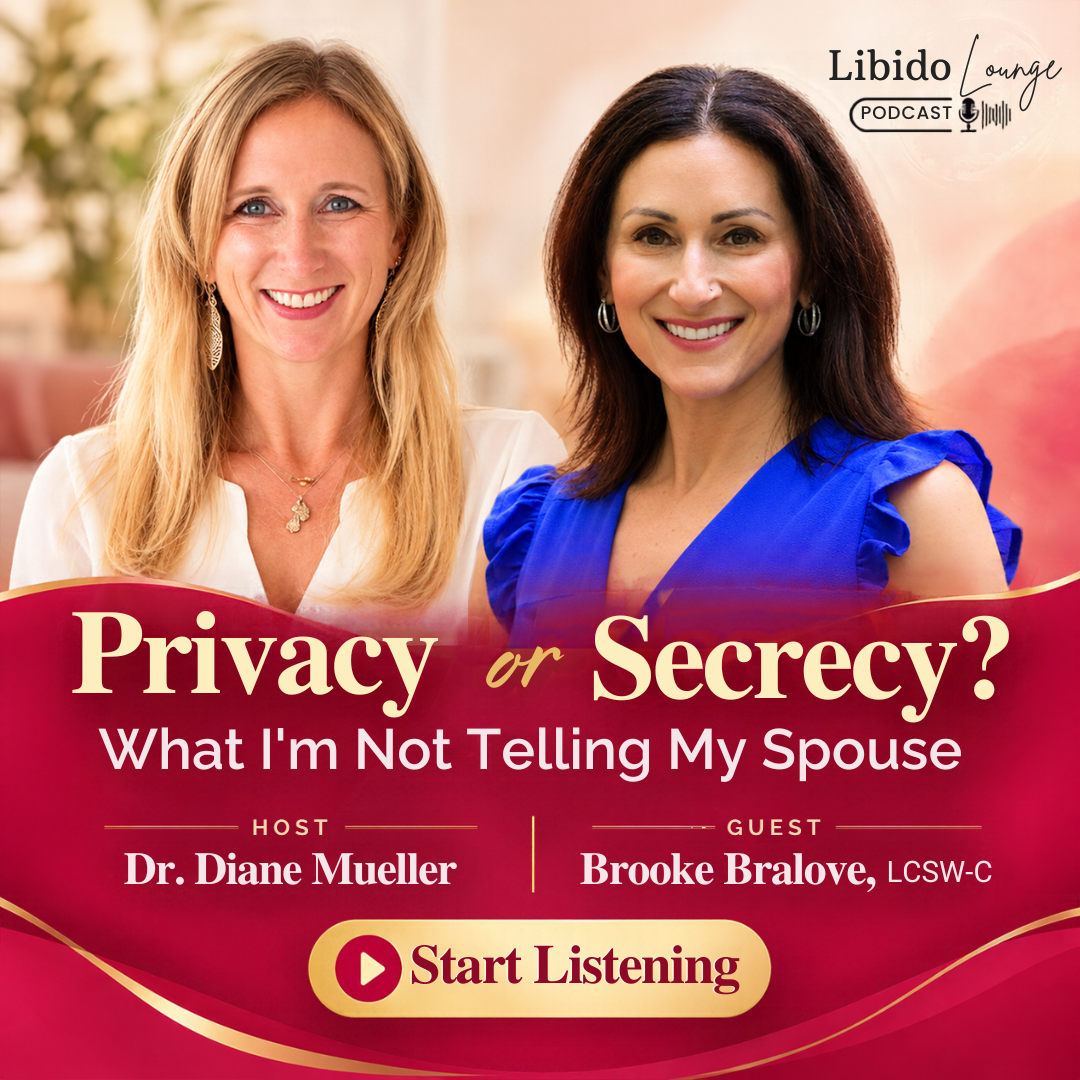
Is every secret in your marriage a betrayal—or are some just the private space that keeps desire alive?
In this episode of My Libido Doc, Dr. Diane Mueller sits down with certified sex therapist Brooke Bralove to draw the sharp line between healthy privacy and corrosive secrecy. They dig into why couples demand total transparency yet choke on the details of past lovers, how the “would I do this in front of them” test exposes what’s really at stake, and why the wrong disclosure can kill willingness while the right boundaries protect it. Desire mismatch, childhood silence around sex, and the quiet damage of little-T wounds all get pulled into the light. This is the conversation for any woman who’s felt the weight of what to share, what to withhold, and how both choices land in the bedroom.
You won’t want to miss this if you’ve ever wondered whether your silence is protecting the relationship or slowly starving it.
About Brooke Bralove, LCSW-C
Brooke Bralove, LCSW-C, is a Licensed Clinical Social Worker, psychotherapist, AASECT Certified Sex Therapist, and expert in trauma, sexual health, and emotional healing. With over 20 years in private practice, she helps individuals and couples overcome anxiety, trauma, and relationship challenges so they can feel more connected, confident, and fully themselves.?Brooke integrates neuroscience-based approaches, including Accelerated Resolution Therapy (ART), to create rapid and lasting change. She is a sought-after speaker known for her warmth, insight, and ability to translate complex emotional and neurological processes into practical, transformative tools.
https://www.brookebralove.com?https://www.facebook.com/brookebralovepsychotherapy/?https://www.instagram.com/brookebralovepsychotherapy ?https://www.tiktok.com/@bbralovepsychotherapy ?https://www.linkedin.com/in/brookebralovepsychotherapy/?https://www.youtube.com/@brookebralovepsychotherapy
Table of Contents
Privacy vs Secrecy in Marriage Part 1
Dr. Diane: Hey everyone, welcome back to another episode of the Libido Lounge. I’m your host Dr. Diane Mueller and I have a real treat for you all today. I have Brooke Bralove with me on our show today. She’s a licensed clinical social worker, a psychotherapist, a certified sex therapist, an expert in trauma, sexual health, and emotional healing. And I wanted to bring her on today to talk about all sorts of things. We’re going to talk about desire mismatch. We’re going to talk about little t traumas and these small things that happen in our relationship that actually have pretty big impacts on intimacy, both emotional as well as our physical and sexual intimacy and so much more. And as always, we will be talking to Brooke over a series of a couple episodes. So make sure you are subscribed to the channel so that you can get the notification when episode two comes out. So excited to be with you today, Brooke. Welcome to the lounge.
Brooke: Thank you so much for having me.
Why Scheduling Sex Matters More Than Spontaneity
Dr. Diane: So I want to jump right in. One of the things that I am curious about about your work is you work with so many couples. You talk to people all the time in and out every week and I’m curious is there one thing that you see over and over and over again that you find yourself saying like gosh this is like the hardest thing I have to tell people and I have to tell people this over and over and over again. If you could pick one thing what would it be and I know that’s a little bit of a tricky question so if you need to pick two things that’s totally fine.
Brooke: Oh it’s such a great question right off the bat. I would say that the thing I say ad nauseam is you need to schedule sex. People hate it. They’re pissed off, especially men. And at the outset of this, I do want to say that I mostly work with cis hetero couples and so that’s going to be a little bit of my bias today and I just want to own that. So a lot of men really don’t want to do that. And I think partially it’s because of the way they don’t like to schedule a lot of things, right? So you know, often moms and wives are the ones scheduling the social stuff, the playdates, everything, you know, that goes into it, the doctor’s appointments, the camp schedule, everything. And so part of it is I just think there’s resistance to actually scheduling anything or being that organized. But secondly, it’s that men believe that only good sex can be spontaneous or only spontaneous sex is good sex. And that’s simply not true and not what the research shows or what we actually find works in long-term couples. So that’s the biggest barrier is that you know I just got to say you got to schedule it. I don’t really care that you’re annoyed by that answer.
Dr. Diane: So I’m curious because I say this a lot share that that belief and I say this a lot too. Have you found anything especially in talking to the gentlemen? Have you found anything that helps them kind of understand the importance of this and get over that belief that it has to be spontaneous? Like what do you say when you get pushed back to help motivate people to actually start prioritizing the schedule?
Brooke: So I usually say two things. The first is you schedule all the things that matter to you, right? And again this goes for you know any gender. You schedule Pilates, you schedule lunch dates with friends, you schedule time with your kids and activities with them. So we schedule what matters to us. We prioritize things and then we plan for them. And so why do you believe that somehow this is the one thing that’s just going to happen spontaneously in your life? So that’s the first and foremost. The second thing I say is when you create a space for sex, whether that’s intercourse or cuddling or a massage, you actually create anticipation. And anticipation is what leads to desire. And desire can often lead to arousal. So you’re actually setting the stage for yourself and it’s more likely to go well. And especially for women who have trouble transitioning from, you know, wiping snotty noses to take off your clothes and let’s get you wet. That’s a really hard transition. So when you have it on the calendar, when you’ve scheduled this space, you know, this sexy space, this sexy time, it can be anything you want, but it actually creates the anticipation that helps fuel everything around the experience.
Desire Mismatch: Why Comparison Kills Connection
Dr. Diane: I want to talk about desire because I think one of the areas too that people get push back is this comparison thing that happens right around you know what is normal what is not and you know for most people they don’t have exposure to conversations like this and most people are not sitting around the dinner table when they’re having dinner parties talking to their friends about sex. I’m really fortunate I’m in a group of friends where we have regular dinner parties and it’s not that we sit around and talk about sex all the time, but if one of if one couple has like found some sort of new fun technique that they’re enjoying in their sex life or this new thing they’re doing, they share it. And so we’ll have these open conversations around challenges and struggles and things we’re learning and it’s really pretty unique. But a lot of people don’t have that. So what do you find around desire? Like is there a normal amount of desire that happens? Do you feel like comparison is a problem? Like how much how I guess the question is like how much is it important for people to actually be like looking at their relationship and saying okay well this is normal or this is not and how I have a problem.
Brooke: I believe that when you talk about desire there’s no right and wrong. There’s no level. There’s no number we can ascribe to. And comparing desire is futile. It’s just not going to work because sex is comprised of so many things, right? Arousal, desire, closeness, intimacy, did your partner show up for you in other ways that you now desire them? There is no doubt that loading the dishwasher can be a huge point of creating desire in a marriage. Doing acts of service. I mean, and women will tell you, you know, when he just puts the kids down for a nap and just says, “You look a little tired. Why don’t you go lay down? You can have a little nap. I got it.” There is no doubt that that woman is going to be not necessarily turned on that exact second, but I guarantee you she’s much more willing to try. So do not compare. It doesn’t help. And you always feel either better than or less than, but that doesn’t stay forever because you’re going to have weeks, months where you’re not going to have the same kind of desire in a long-term relationship. And so I think that’s not a great idea to do that. And the other thing I say is the only two people who have to be okay with the amount of desire, the amount of sex are the two people in the relationship. That’s it. No one else has to go, I agree with that or that sounds normal to me. Nobody. Now, are there things called sexless marriages where we would say it doesn’t sound like there’s a lot of desire or commitment to work on the relationship? Sure. You know, we sort of decide as sex therapists that a sexless marriage is usually where you haven’t had any sort of sex in a year because that’s really taking the element out of the marriage for a significant amount of time. But there are couples that exist in sexless marriages that are okay with that for a variety of reasons. That’s not the couples that I see, right? I’m not seeing couples who are like, “We barely have sex. We’re totally happy with it.” It is usually a mismatch in desire. So mismatches in desire are super common. In fact, you cannot have the exact same libido as anyone else. You can’t have the same turn-ons for desire. It’s, you know, you hope they line up, but there’s always a mismatch. So what I look at is not in terms of mismatched desires, but how mismatched are they? The name itself is really not important because everybody has them. So I normalize that right away. How could you possibly want sex at the exact same time, the exact same amount, the exact same way as another human? It just doesn’t work like that. And so we are looking at how wide that gap is. And when it’s too wide, that’s usually when I say it sounds like there’s something you want to talk about. And it doesn’t mean they have to come to me. They can talk about it with their partners. The problem is very few couples have any ability to talk about something as vulnerable and touchy as sex without another person helping them. Especially when it’s already a problem.
Dr. Diane: Yeah. We’re really just not given tools about it, you know. And even in education, it’s like the biggest thing I think most of us got in education from a school standpoint was PNV sex and it was just like very anatomical. So it is a it is something it’s like not modeled anywhere. We’re generally not hearing our parents, our elders talk about it, is not talked about in school. So it’s pretty easy to understand I think why this is something that we’re just not skilled at it.
Uncovering Root Causes of Desire Issues
Dr. Diane: So I’m curious in your work like as couples come in and they’re talking to you about low desire or desire mismatch and clearly it’s causing some level of distress in their relationship because they’re sitting in front of you. How do you tease apart in your work some of the root causes? Like how do you tease apart like how much of it is relationship meaning their inter relational dynamic versus the body, hormones, medication, exhaustion from living in our modern day society. So I’m just curious about your process if you would tell us a little bit about like how how people really start to uncover, you know, what the root causes are and and start to rebuild and repair.
Brooke: Yeah. I just want to take a quick break to say one of the number one things that leads to a lack or just a slowing of passion in the relationship is thinking that our partner’s body and mind and spirit is going to be the same today as tomorrow. So one of the things that happens for so many bodies, especially for female bodies, is that with time, the pleasure needs change. And we get into those sexual scripts and those habits of doing the same thing over and over and over again, not always realizing that our pleasure body is wanting something else. This creates a lack of passion, a desire, a lack of orgasm, and is one of the reasons why bedrooms can start to get quieter. I talk about how to fix this and so much more walking you through a step-by-step guide for an entire year if you want on how to improve your pleasure life. Start with a free trial, stay for a month, stay for the year, make it yours. You’ll see all of this and more and how to get started in the show notes below this video. I hope you will join me in my hot monogamy society. Now, let’s get back to our episode. So this is where we want to look at sex and you know relationship sex and as you said desire. We want to look at the bio psychosocial right and so in a first session I’m going to find out what’s bringing them in. When I see couples, I always do one session with each of them individually. And that’s where I’m going to do more of this type of assessment. And I don’t hold secrets. I tell couples all the time, I won’t hold secrets, but your partner doesn’t necessarily need to be there for the details of how many people you’ve had sex with and what positions you’ve tried. You know, some of that is, I think, personal. And I do want to I think there’s privacy and secrecy and those are very different. And so I do think we’re entitled to some privacy around that. So still when I let’s say I’m working, you know, I see the man for one individual session to kind of assess. So I do a sexual timeline kind of first and foremost just tell me when you first were aware of your genitals. Tell me when you first masturbated. Tell me, did you have wet dreams? What messages did you get? Childhood messages are a massive component of to try to kind of tease out what’s going on. And sometimes, I love this, people will say, “Well, my parents were fine about sex.” And I’ll say, “Oh, okay. So they openly talked about it.” And then they’ll say, “No, no one ever said a word.” And I would say that’s a loud message that they never said a word. Right? And people are like, “Oh, I never thought of it that way.” So childhood messages will go through. We definitely go through medications. We go through, you know, have you had your testosterone? Let’s say this is the person with low desire. We would want to go through, have you had your testosterone check? What medications are you on that might be contributing to that? Or if they’re coming in for erectile dysfunction or, you know, inability to have an orgasm. Again, we’re gonna want to tease out the biological kind of as the baseline because if you’ve got low T, like then that’s impacting everything else. So we have to fix that first or address that first. Once we’ve ruled out some biological stuff or maybe even, you know, fixed some biological stuff, then we are certainly looking at stress, relationship, happiness. How we’re looking at other types of touch. Is your partner touching you outside of the bedroom in ways that feel good to you? Are your emotional needs being met? And then most importantly, what do you think is happening? How do you understand this change inside yourself? Does it feel like it’s about aging? Does it feel like it’s about boredom? Does it feel like it’s about attraction? And so I’m really going to want to tease that out, too. But again, you always start biological, psychological, and then the social, meaning the interaction between the members of the couple or throuple maybe even.
Dr. Diane: I love that and I think it’s such an important thing. One of the things I appreciate with what you’re saying that I hope everybody is hearing in this is there’s layers of this and oftentimes there’s more than one layer. And I think one of the problems people get into is like is thinking that there’s only one cause and because of everything that can go awry biologically as well as all the training we’ve had growing up and this the inability to have people around us that are talking about sex in a healthy way. There’s just so many different layers of what can cause a desire mismatch. One of my favorite biological ways to really help people is using pumps. And so pumps are suction devices that have a like vacuum suction tool to it. And they make men’s versions that you have the suction device that kind of goes with this tube. There’s many different sizes of these. And then the female version has like one for the clitoris as well as one for the entire bulbar structure. And what’s so great about these is the ones that are good vacuums, not all of them are the same and some of them can actually cause problems, but the ones that are truly great medical grade devices like this one, one of the things we’ll see is that there’s improvements, major improvements in things like it with ED or even if it’s not true ED, just having imbalances where maybe men are not getting quite as hard or they’re going soft easier. It’s just not as full of an erection as it used to be. And you know, in these things, I think it’s like that that circuitous scenario where if something’s going wrong physically, that can impact the mental. And so we want to dissect the mental, but we also want to work with the mental by saying, let’s fix the physical so there’s not that problem. And for women, there’s so much to be said about getting blood to the vulva and to the clitoris as we need circulation as women just like the men do. It’s just another area that’s not talked about as much.
Privacy vs Secrecy in Marriage: Is It OK to Keep Secrets in a Relationship?
Dr. Diane: So I want to ask you this because you said something that is, I think, really important for people to delineate, which is privacy versus secrecy. And I was watching an episode of Seinfeld last night. You’re making me think of before bed. I was re-watching this episode and it was George was in a relationship. For anybody that’s listening and know Seinfeld, one of the characters was in a relationship and his fiancée was basically saying, “We’re a couple now. So this means we tell each other everything. It’s just a rule.” And so I think there’s some level sometimes of this like expectation around, hey, we’re a couple. It’s wrong if we don’t share everything with each other. But yet there’s this real privacy thing that happens. And oftentimes, like you said, like it’s not beneficial for a couple to maybe know every single thing about a previous about their partner’s previous lovers. So how do you delineate that for people? How do people how do you coach people in therapy around maintaining that healthy privacy without having this like secret thing that could be happening and causing harm to the relationship?
Healthy Privacy in a Relationship vs Keeping Secrets
Brooke: So when you’re delineating between privacy and secrecy, I think there are a couple questions you need to ask. One is if it’s current behavior like should I tell my partner that I’m doing X? The question that matters is would I do it in front of them? And how do I imagine it will make them feel? And I think you need to hold those two things. And mostly it’s really the first one. Would I do? Would I flirt with this man that I work with in front of my partner? The answer for some people might be, oh yeah, it’s harmless. He would think it was funny. That’s fine. And so I think that is simply just privacy. It’s not really important. It’s not really relevant. But if the answer is absolutely not, he’s incredibly jealous and we would have a huge fight and it would lead to a month of, you know, really difficult stuff. That’s secrecy. That’s saying this will impact our relationship in this moment. So I think that’s really important. And then the second question I think that matters when you’re delineating, you know, privacy from secrecy is does this hurt my partner for no reason? It is not necessary. Like you know there’s often this is it necessary, is it kind? You know, when you’re trying to say something and I think it matters here with privacy and secrecy, too. So telling your partner that their dick is not the biggest dick you’ve ever seen and naming the one partner’s dick who you also were madly in love with and said that’s the biggest dick I’ve ever seen. That’s the best sex I’ve ever had. That is hurtful for no reason. There’s nothing to gain from that. So you got to ask yourself these two questions. And I think that’s a great guide.
Telling Partner About Past Relationships: Where Privacy Protects Desire
Dr. Diane: Yeah, I love that. I think it’s a really helpful thing. And the thing that you said that I hear so many people say around like, is this truthful? Is it necessary? Is it kind? Right. And if it’s not if it doesn’t meet all three of those, then maybe we shouldn’t be saying it. This is a really good lead in to what I want to talk to you about in part two. In part two, we’re going to talk about little t traumas. So these tiny little things that sometimes get said to each other or or done to each other, right? These tiny little things that often times actually can have big results in our body. And this could be interrelational little t traumas. This could be little t traumas from our past life, from things that we grew up with. You know, our life before our partner is what I mean by that. So we’re going to talk about all of that in the next episode. But I also want to talk about shame because shame is a really big thing that oftentimes people don’t identify with having shame. But it’s very common that we have these subtle shames or we shame ourselves in certain ways and we don’t even realize we do it because maybe we saw our parents do it. But so it’s modeled to us and it just seems normal and we don’t even realize the harm it’s having. So we’re going to talk about all of that and more in the next episode. Make sure you do subscribe to get that.
How to Work with Brooke Bralove
Dr. Diane: Before we go though, I want to make sure that we allow you to talk about a little bit about what you do as far as your practice, how people get a hold of you, how people work with you. We’ll have all of your links and information in the show notes, but could you just tell us like the next step for people getting to getting to work with you?
Brooke: Sure. So you can send me an email or fill out a contact form on my website, brookebralove.com. You can also follow me on Instagram @broolo.psychotherapy. Same thing for Facebook. I’m also on TikTok. So those are great ways. Sex therapy can be done virtually or in person. And I really at the moment I’m kind of specializing in this brief treatment called Accelerated Resolution Therapy ART. And that has a wonderful connection to sex therapy and can really move things like libido or desire or erectile dysfunction or these little t traumas and can move it in one to five sessions using some rapid eye movement.
Dr. Diane: Amazing. Well, thank you everybody for listening. Thank you Brooke for being here. Please do subscribe so you get the next one coming and we’ll see you all again on our next episode on the lounge.
Dr. Diane: Thank you for listening to the Libido Lounge. Please don’t keep me a secret. Please share this with your friends. You can find me on YouTube, on Instagram, and check out our Modern Libido Club for so much more!
What Little T Trauma Really Means for Your Sex Life and Intimacy Part 2
Dr. Diane: So, I want if you would to make sure help everybody get on the same page with this little t trauma thing. Can you give us some examples of what types of little t trauma experiences somebody might have had just to allow people to start thinking about things like, “Oh, that might have impacted me more than I realized,” because sometimes I think we kind of brush off little t traumas as like well it’s not that big of a deal. Sometimes we gaslight ourselves. So can you kind of root us in first of all some examples of what little t experiences could be and give us an understanding of how they impact our sex life and our intimacy life sometimes even 20 years after they happen.
Brooke: Yeah. Yeah. So I think it is really important because I do find that people come in and when you say have you had any trauma they go oh no not at all and you dig a little deeper and you hear things like I was belittled by my mother my entire life growing up or people made fun of my big hips when I was in high school. And you know what we are really talking about when we talk about trauma is simply the question of did it overwhelm your nervous system in a way that you could not process and work through in any sort of way. And when you look at trauma like that then it really doesn’t matter whether you call it big T trauma or little T trauma. But I’m not saying that that is a helpful delineation because some people have a really hard time accepting that being told they had wide hips might be interfering with their ability to be present in the bedroom. And when you point it out and sometimes using the accelerated resolution therapy can help you connect those negative sensations like some shame that’s coming up or tightness in your chest or some version that would happen when someone was teasing you about your hips and it’s happening again when you get naked in front of your partner. We can actually find that connection through the body. But people diminish these things over and over again. And actually some of the time my first job is to just teach them what trauma actually means for the body and then say, you know, I think this might have had a bigger effect on you than you had really ever thought about. Cuz they’ll say things like, I mean, whatever. No biggie. I was teased. And then I’ll say, well, how do you feel about your hips now? and they’ll say, “I’m disgusting and fat and I cannot believe I let myself look like this after two kids.” Right? So those messages, it’s often about childhood messages that we think we should be able to quote get over and that we’ve decided are just things everybody goes through, but not necessarily. And then of course we have to link it to the present. How is that impacting you right now? And so that’s kind of my main thing. I’ll give you some examples of some other little t traumas. It could be that you had test anxiety. It could be that the first time you talked to a boy when you were 13, he laughed in your face. And then you had another experience in college where something like that happened that was similar. You were rejected. You were made fun of. And again, it’s how it’s showing up now that is the important question. If it’s not bothering you now and you have no problems having to do with rejection or how we initiate sex, then I don’t think we need to look at it. But if you’re in my office, there’s almost always a root cause and that’s almost always little t trauma.
Signs That Little T Trauma Might Be Affecting Your Desire and Relationship
Dr. Diane: So do you see, I mean, so somebody being in your office, so that could be a sign of little t trauma. Do you see other things that are commonalities that people might watch out for to say, “Oh, well, I’m doing XYZ or I’m feeling XYZ or I’m having this sort of experience that it would be signs for them to say, hey, there might be something here and I maybe I should seek out somebody such as yourself to process things like are there anything that people can look out for that could be key notes for them to start thinking that this might be something worth exploring?”
Brooke: Yeah, I think there are some signs that therapy or sex therapy might be beneficial. One is, is it impacting you now in a way that is overly distressing, causing harm in your relationship, and feels really bad even though you’ve tried to address it on your own, right? You’ve done the you’ve read the books, you’ve listened to the podcast like yours, you’ve done the homework, so to speak, and it’s not budging. It’s not changing. Then I think you’re going to look at is this about something else? Is there just something that not that like I don’t remember from my past necessarily, but just that I’ve kind of overlooked that might be unconscious. That’s what drives so much of mismatched libidos and desire discrepancies and boredom, things like that. And so you might want to talk to someone who specializes in this to just dig around. The second question I always want people to ask themselves is let’s say you’re in the present and you know you have erectile dysfunction and you quickly put your clothes back on and just move away because you are so deep in shame. What you want to ask yourself is when have I felt this way before? And if you have anything that comes up, huh, I felt this way when I failed the entrance exam to my profession or I felt this way when the first time I approached a girl and I felt like I failed and I was not attractive and unwanted. If you felt that way before, that’s a really good indication that there’s a little t trauma. Of course, it could be a big T trauma, but you know, today we’re talking about little t.
Dr. Diane: Yeah. Yeah. Thank you. It’s very, very helpful.
Perfectionism, Shame, and Why Confidence Matters More Than a Perfect Body
Dr. Diane: And then talking about things like perfectionism because I know perfectionism comes up for a lot of people. So, where does that play a role with shame, with little t traumas? What does it look like during sex? Can you talk to us a little bit about where perfectionism plays a role.
Brooke: I’m so glad you talked about that because I do specialize in perfectionism, not just in the bedroom, but elsewhere. And it’s not that men are not perfectionists, but we find that it’s really most common in women in how it’s manifesting. So, when you talk about perfectionism, first of all, it’s a 20 ton shield that you carry around that is unattainable. There’s no such thing as a perfect person, a perfect body, a perfect diet, a perfect face, anything. So, I always say that perfectionism sets you up to always fail every time. It’s a guarantee that you’re going to fail because it doesn’t exist. So, in some ways, it’s really stupid and not particularly smart to be a perfectionist because you’re basically just saying, “I’m going to fail every time.” So, I look at something obviously different called healthy striving, which is always to do your best and really want to do well and show up in the best way you can, but sometimes it’s going to go well and sometimes it’s not. And so, perfectionism in the bedroom really shows up for women around their bodies. I can’t go on a date until I lose 30 pounds. I better get Botox to convince the younger man that I’m going out with that I’m actually in my 40s, not my 50s. I need to give the perfect blowjob and study it and that’s the only way I’m going to get a guy to like me. Those are some of the thoughts. I really see it mostly around bodies that people don’t feel good enough and perfect enough to be sexual and that’s not true. All bodies can feel pleasure. All bodies, all ages, all sizes, all colors. And you know what? One of the things I usually ask people when they’re like, “But my stomach’s a little poochy because of, you know, I’m still I still have the baby weight and things like that.” And I’ll say, “About how many times has your partner kicked you out of bed just about how many because of the way you look? How many?” You know, and of course they go, “Never.” I go, “Okay, then I think we know what’s going to happen.” And you know, I do often encourage women to fake confidence just a little bit, like to almost like roleplay confidence a little bit, because I do find that when you act it out, it really does tend to just feel good and then cultivate more confidence. And confidence is what’s sexy, not whether you have the exact flat stomach that you want. That doesn’t matter. It’s confidence that is sexy for your partner and creates sexy inside of you.
Dr. Diane: I couldn’t agree more and I want to name that one of there’s so many ways, right, that we gain confidence. And like we’ve said throughout our conversation, there’s many different ways we want to approach confidence and approach our sex lives, especially in healing root causes of things when they’ve gotten out of balance. But one of my favorite simple ways of increasing confidence is through the pump. So, one thing that I’ve heard from women as they age is sometimes this feeling of being all dried up and being embarrassed about it and not wanting to tell their partner about it. For men, it’s realizing that their erections are not what they were in their 30s, 40s, 50s, and beyond that they were in their 20s. And when we do things like pump, we allow ourselves to get some confidence back because for women, these pumps that are the vulva or the clitoral pumps and they’re vacuums. It’s a vacuum device that goes onto these pumps and it has been shown to really increase vaginal lubrication. I’ve seen that personally as well as professionally. And then for men, we also have the cylinder pumps. There’s many different sizes. And then of course we have our vacuum suction. And same thing for men when we are using these pumps we see often times erections go back to what they were in the younger age. So whether it is hey I don’t have I have ED or whether it’s not ED and it’s just that things aren’t working as well as they used to or you just want to stay healthy as you age to maintain make sure you maintain healthy erections and blood flow. The pumps are just awesome. They’re not all the same. So, make sure you do go in the show notes where you’ll also find coupon codes of how to get them.
Intimacy After Infidelity or Betrayal: Who Sets the Timeline and Can Desire Return
Dr. Diane: Now, I want to talk to you, Brooke, about intimacy after infidelity or betrayal because and I want people as they’re listening to this question and answer, think about infidelity or betrayal beyond just sexual intimacy, right? So, yes, this could involve a partner sexually cheating on you. But I know a lot of times people feel like their partner has had some sort of like emotional affair with another person, right? Where maybe some level of boundary or some agreement, whether talked about or just assumed, was broken. So, just as you’re listening, think about, okay, well, if there was damage from a true sexual infidelity or if there was some other agreement that just got broke. What do you tell couples as far as like when can this be repaired? When can it not be repaired? Can we be stronger after the relationship or after this is repaired? Is that just a story that people say? Can you just talk to us a little bit about that?
Brooke: So I think obviously this is going to be different for all couples, but the one thing that I do think is most important is the person who has been betrayed is the person to set the timeline. And it doesn’t mean they have to know what the timeline is, but they must lead the intimacy. Because if you have intimacy too soon, too quickly, it can really get kind of confusing. And I think that it’s just important for the person to lead the way. They have the control because the real hurt of an affair or an emotional affair, physical affair, whatever is that they had no choice. It was done to them. They had no say. They were helpless. They were most of the time in the dark. And so I think you have to shift that power immediately for the person who is betrayed to feel like they want to even continue to engage. The second thing is it’s not my job to decide if they can repair. And so that’s completely personal. I’m usually seeing people who want to repair. That’s why they’re there. And so I work with people exactly where they are. And I’ll ask the person who’s been betrayed, you know, how are you feeling? How are you feeling toward your partner? How do you feel about your physical relationship? And most people will just say, I’m just not ready, you know, right away in the first month or two. But there’s no specific timeline. It’s all about that person feeling like they are in control of what happens next. One thing I do find anecdotally because it’s just the people I see obviously is that there often is a strange thing that occurs where desire increases after an affair. And sometimes people end up having actually the best sex they’ve ever had after an affair. Do I fully understand why? Not really. I do think that making something like having something feel like it could be taken from you at any time, the uncertainty of is that person going to be there? Are they not going to be there? Actually creates desire, right? Boredom happens in sexual relationships when it’s like there they are again. They’re to the right of me. They’re to the left of me. They’re in the kitchen. They’re in the bedroom. They’re cutting their toenails. I don’t find that very attractive, you know. So, kind of taking that safety away increases desire. I’m certainly not saying that I think affairs are always good at all, but I’m also not saying they’re always terrible. They do often lead to a greater understanding of each other once you build the trust. So, I do think you can deepen a relationship. You can renegotiate boundaries if that’s appropriate. You can understand more about what something meant to someone. And it usually shows what they were lacking, but it doesn’t usually show what was lacking in the marriage. I often think affairs are about what feeling is lacking in the person that did the betrayal that was the quote perpetrator of that betrayal. It’s what feeling are they getting from going outside the relationship that they’re not getting inside the relationship. And I certainly don’t think they can blame the other partner. And I do think marriages are co-created. And I do think that not that the choice to have an affair or go outside is co-created, but the dynamics that are in place are co-created. So that’s kind of how I see things.
Dr. Diane: I love this distinction and it’s such a message of hope post that which I really appreciate. And I also really think it’s a good way of almost like taking control of those scenarios and actually realizing that oh like what you’re saying around this feeling being personal around how if we understand what feeling we were trying to chase outside of our relationship. We can bring that and what I’m hearing to say, oh this is a feeling that is actually really important for me to experience. And then through working with our partner, working with a therapist like yourself, then we can take a step back and say, “Okay, well, how can I get this type of feeling that I want within the context of my marriage and like you said, renegotiate that.” So, I just love your approach so much.
How to Know When It’s Time for Sex Therapy and How to Connect with Brooke
Dr. Diane: I want to make sure to respect your time here and let you tell us a little bit about how couples get started working with you and also as you’re talking about this like how would a couple how do you advise couples to know whether or not it’s time for them to start working with a sex therapist like yourself?
Brooke: I think the way you figure out if you need sex therapy is have we used the tools at our disposal to address this? Have we talked about it? Have we researched it? Have we had a series of conversations about it? Can we even talk about it at all? And if certainly if the answer to that is no, then I definitely think having a third party who’s trained to facilitate these kind of vulnerable scary conversations is really important. The second thing is do I feel like this is something to do with my experience growing up in adolescence in with other relationships when it’s a pattern when it’s something you know if you realize that huh three years into all my relationships I seem to not feel attracted to my partner that’s an unconscious thing that’s happening so I think going to sex therapy is extremely important then.
Dr. Diane: Amazing. And then how do people get a hold of you?
Brooke: Yeah, you can find me on Instagram and Facebook, brookebralovepsychotherapy. DM me there. And you can also find me on my website at brookebralove.com. And you know, sex therapy can be done in person or virtually. So, we’ve got a lot of flexibility there.
Dr. Diane: Amazing. Thank you so much for joining me today, Brooke. And thank you everybody for your time and attention. Please do check out Brooke’s work if she can serve you. That information will be in the show notes for you. And please do subscribe to continue to get more information on sex, intimacy, love, relationships, and so much more. It is a pleasure as always to be with you all, and we’ll see you again soon on another episode of the Libido Lounge.
Thank you for listening to the Libido Lounge. Please don’t keep me a secret. Please share this with your friends. You can find me on YouTube, on Instagram, and check out our Modern Libido Club for so much more!

Want Part TWO of this Episode?
Each podcast interview includes Part ONE of the interview.
Join the Libido Club to unlock the complete conversation.
Our Advocacy:
Our advocacy is centered around providing a supportive space for women to reclaim sexual vitality and joy for good. Help us achieve this by subscribing to our podcast and sharing us with your friends and family.
 Ready for a Hot and More Modern Version of Monogamy?
Join the Club: https://mylibidodoc.com/club
Access Lab Testing: https://platinumself.circle.so/c/community
More Libido Lounge
 Website | mylibidodoc.com/podcasts/
YouTube | youtube.com/@mylibidodoc
Instagram |https://www.instagram.com/myromancedoc/
Facebook | https://www.facebook.com/myromancedoc
Health Store | https://store.mylibidodoc.com/