What if every casual touch in your marriage has started to feel like a silent demand for sex—and that pressure is the exact thing shutting desire down?
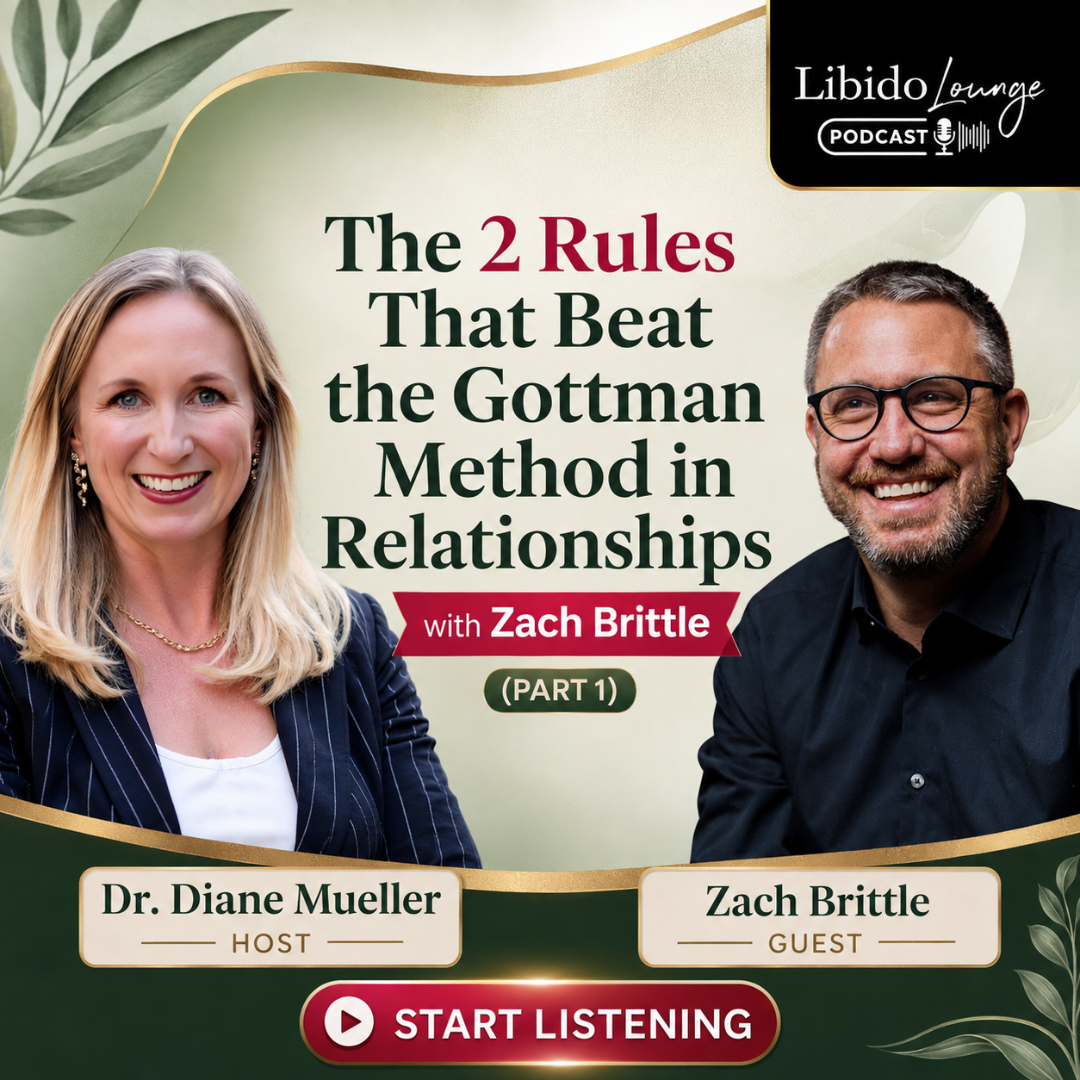
In this raw conversation, Dr. Diane Mueller sits down with relationship therapist Zach Brittle to dismantle the myth that physical closeness and sexual intimacy are the same thing. They dig into why the lower-desire partner often freezes or pulls away when affection stops feeling safe, how cultural training never taught us intimacy in the first place (only survival), and why contempt—the quiet “I’m better than you”—is the one relationship toxin with zero redeeming value. You’ll hear the practical distinction between non-sexual touch that rebuilds safety and the kind of sexual intimacy that doesn’t even require bodies in the same room, plus the two simple questions that cut through shame and performance pressure so couples can stop negotiating frequency and start reclaiming actual connection.
You won’t want to miss this if you’ve ever braced yourself for a kiss because you already know where it’s expected to lead.
About Zach Brittle
Zach Brittle has been teaching, coaching, mentoring, and counseling couples for nearly 20 years. He’s a Licensed Mental Health Counselor (LMHC) in Washington, a Certified Gottman Therapist (CGT), and a Relational Life Therapist, the only therapist in the world certified in both. He’s the host of Marriage Therapy Radio and the author of the bestselling The Relationship Alphabet and Marriage Therapy Journal. His work has been featured in Vanity Fair, Men’s Health, Real Simple, The New York Times, and The Washington Post. Zach has been happily married to his wife Rebecca for 25 of 28 years. They live in Seattle with their two adult daughters. Learn more at zachbrittle.com.
Instagram: https://www.instagram.com/marriagetherapyradio/?hl=en Facebook: https://www.facebook.com/marriagetherapyradio/ Podcast: https://podcasts.apple.com/us/podcast/marriage-therapy-radio/id1295458667 Website: https://zachbrittle.com/ Substack: https://zachbrittle.substack.com/
Table of Contents
Physical Intimacy vs Sexual Intimacy: Why the Confusion Keeps Killing Desire
Dr. Diane: Hey everyone, we are back. Another episode of the Libido Lounge. I’m your host, Dr. Diane Mueller, and we are back with Zach Brittle for part two. If you did not listen to part one, make sure you go listen to that in the show notes. We talked about things such as how to use things around the Gottman therapy, things around perpetual problems versus manageable problems, how you deal with different types of problems, how you work with them, how you can work and be married and be in relationship to one person for so many years, but that relationship takes many different forms and how to work with those transitional times and more. So listen to part one below. And as a quick reminder, Zach is a licensed mental health counselor. He has been in this field for 20 years. He’s the host of the Marriage Therapy Radio podcast and author of the best-selling books, The Relationship Alphabet and The Marriage Therapy Journal. So, first of all, welcome back, Zach. It’s good to have you again.
Zach: Thank you. I’m glad to be here. And I just found out I was part of a contest. So I’m now I’m gonna be on my best behavior to win the
Dr. Diane: Well, we want you to win the best guest category. Perfect. Perfect. We’ll let you guys know about that contest at the end for sure as well as how to work with Zach. So stay tuned for that. Now I want to start going into where we kind of headed like ended up that last show around talking a little bit about desire discrepancy. So I know that a lot of people and it tends to be but of course this is not always how it goes. A lot of times it’s one partner, many times the male, but sometimes the female that is wanting more sex and having no idea how to talk about it without it landing as pressure, without it getting rejected. So, you know, what’s going Can you talk to us about like what’s going on for that person like mentally, emotionally in that position that wants more? Obviously, there can be many different things going on, but some ideas on what’s going on and maybe what’s the better move than than doing it in this way that feels like it’s pressure.
Zach: Oh, man. If I could answer that question right now, then I’m sure it would be like the most famous episode of all time, right? Like this is the age-old question about how to bridge the gap here. I think to me I come at this from a couple different angles. One is that when people are interested in growing or developing their intimacy often in here that’s code for sex like they want more sex but even if I say even if they say physical intimacy that’s still code for sex like but intimacy of course is much more robust right intimacy is emotional intimacy it’s intellectual intimacy physical intimacy I think is different than sexual intimacy physical intimacy is really about proximity how well do we do space together and then sexual intimacy of course is the all the sex part and I think there’s also spiritual intimacy so you know if you want to tackle the sex part of your relationship. I think you what you actually need to do is tackle the intimacy part of your relationship and kind of build up all five of those areas. And if we just if we just narrow in on two of them for your audience, physical intimacy versus sexual intimacy, the thing I the thing I think is really critical is that people have more physical intimacy that’s not sexual and more sexual intimacy that’s not physical. And what I mean by that is like you need to have the ability to just walk around the park together, maybe holding hands. You need to be able to go to the bathroom with the door open. You need to cook together in a way that doesn’t strictly feel like foreplay.
When All Affection Feels Like a Bid for Sex: Why Non-Sexual Touch in Marriage Matters
Zach: I think there’s a lot of complaints, particularly for the low desire partner, that all physical contact is a bid for sex. And when that’s true, it’s very easy to kind of turn off or protect yourself from anything like physical intimacy because it doesn’t feel safe. Alternatively, I think people need to have more sexual intimacy that’s not physical. Meaning, they need to learn how to talk about it. and they need to learn how to like have sexual intimacy on the walk around the lake like when they’re saying, “Hey, well, what do you like and what do you think and how should we think about this and what is that going on?” And I think a lot of people sort of inherit and then invest in these old tropes around sexuality that they never challenge or test. And so it becomes a referendum sometimes on frequency and quality without really being a like a real investigation in what our sex life is meant to be for us. So that’s where I start. I start, you know, I’m not doing sex therapy in my office, but I am doing relationship therapy. And sex is just part of a relationship, not all of a relationship. And I think when you take your eye off the ball and you neglect, say, the other pieces that need attention, that’s where things begin to fall apart. And I think it’s a mistake to zero in on strictly the physical part of sexual intimacy as a solution to this thing that isn’t working for the relationship.
Dr. Diane: How do you feel like we get and do you feel like that we get trained out of intimacy in any way? Like and I know like any of these questions I’m asking I feel like we could go on for hours, right? So there might be many different answers for this, but what are some of the top ways that you see that we get trained out of intimacy? Where does shame play a role in this? What other things?
How We Never Got Trained for Non-Sexual Intimacy in the First Place
Zach: I think for starters, we’re never trained into intimacy. Okay. Like I don’t I think when we are young and we are growing up in our homes without labeling it strictly this way and almost no like 14-year-old would say this but between you know 8 to 14 you’re not working on intimacy you’re working on survival and sanity and so you develop those strategies and you develop them as ways to help make sense of your space on the planet. And you know I think everybody has trauma some of that trauma is capital T trauma. Some of that trauma is lowercase t trauma. The world is not helping you. The world isn’t training you for intimacy. The world is training you for survival. And so these traumas that are coming at you require you to if we stick with like purely psychological language require you to fight, flight or fix, fight, flee or fix. And we learn those in our early adolescence and we perfect them. And it’s not until we are sort of forced to grapple with another human being who wants to live intimately with us that we have to kind of train retrain some of those muscles. And so I don’t know that we’re trained out of it is I think it’s more like we’re never trained into it unless it becomes something that we’re really intentional about or that our families are intentional about, you know, that our some some families obviously they have they do a great job of cultivating that and helping people understand how sex works and how sex works relative to shame and how you know sex positive is different than what I mean there’s all kinds right and so I think part of it is just like culturally we’re not we’re not actually all that interested in intimacy where there’s a ton of interest in sex but you know I always tell people that the sexiest sex actually here’s here here’s what I always tell people. If you think right now about all of the sex that you have encountered in the public domain like whether that’s pornography or romcoms or you know even just uh you know magazines in the checkout line at the grocery store almost all of the sexy sex is not between a man and a woman who are married to each other. Yeah. Almost all the sexy sex is you know is scandalous or it’s you know hyper sexy. it’s separate from the work of intimacy. And so I think, you know, we’ve been trained that sex and intimacy aren’t the same or intimate sex is something that kind of belongs in this other other sacred place over there that we don’t really have access to and nobody’s really talking about. I think one time we got to go into Claire and Phil Dunphy’s bedroom from Modern Family. One time they were having sex and their kids busted in on them is the only time I can think of that I’ve seen a married couple on television having sex with each other. And that’s astounding. It’s almost like we’ve said, “No, married sex isn’t sexy. It’s something else.” And I don’t I think you have to disabuse people of that.
Dr. Diane: Yeah. It reminds me of the saying around that I think applies to a lot of situations in health, wellness, psychology, which is it’s not your fault, but it is your responsibility. Meaning like, okay, well, it was society, it was programming, it’s TV, it’s media, it’s all these things that maybe like programmed us out of, you know, or never into intimacy. Like you said, we never got trained. And so it might not be like your fault from childhood not having the program, but if you want a different life, then it’s still our like responsibility to say, okay, well, how do we want to be doing things different and how do we want to train ourselves into intimacy at this point, right?
How to Rebuild Intimacy Without Pressure: Two Questions That Change Everything
Zach: Well, I think there’s two questions that I always pose to clients about how let’s I’ll use I’ll borrow your language, train yourself into intimacy. And particularly if it comes to sex, here’s the two questions. Number one is what is it for? When you thought when you’re thinking about sex and the fact that you’d like to have more of it or you’d like to have different sex, like what? Why? What is it for? Because, you know, when you first meet somebody and sex is great and it’s easy and it’s spontaneous and it’s a thrill and maybe you’re unmarried, you know, so it is still sexy. It’s almost like a job interview and you want to perform, you want to be at your best and then you kind of get the job. Maybe you get married or maybe you whatever and you don’t have to be as diligent as you were before, you know, and then maybe you start having kids and pregnancy sex is different than, you know, just recreational sex. But then maybe you’ve had your kids and now is it for cuz I’ve got the job, I’ve got the kids. What’s what are we doing? Like is it for And so I think where it gets into trouble is where it’s for him or where it’s for her. Unless that’s by agreement. I do have one couple, they have the healthiest sex life of all my clients. They have sex twice a week. Wednesday nights for him, Saturday mornings for her. They have eliminated all questions about initiation and rejection. They have eliminated all questions about who is in charge of a particular moment. They’ve eliminated all expectation for how whether it’s good or not. What it is for them is consistent. It’s a priority. They are creative. They’re thoughtful. They take care of each other. but they’re really clear about what it’s for and they have a really healthy sex life. And then the second question is what counts. Like if sex is, you know, only counts if we have PIV sex that both of us orgasm, then, you know, good luck. I hope that that I hope you get that. But it’s kind of hard to to accomplish, you know, especially with any kind of consistency. Unless you build that skill, which is fine. But like, does it count to make out in the shower? Does it count to just like, you know, pet each other while you’re watching a movie under the blanket while your kids are still in the room? Does it count to talk about it? Does it count to walk into a store and, you know, whack each other with dildos and laugh at the hilarious stuff that you’re never going to you? Like, does that count? Because if the only thing that counts is intercourse, then it’s very easy to put a lot of pressure on, or rather the pressure that is on that, it makes it very easy to avoid, you know?
Dr. Diane: Yeah. Yeah. I couldn’t agree more. I think the way we define it is so limited. And the moment we limit it, the moment we really stick ourselves in a box that it’s just extremely hard to make everybody happy and get their, you know, needs like met and all of that. I want to also talk about shame. So, do you work with shame a lot in your work? Like how does this play a role? Do you find like how much is like shame part of our lives? Is does this come up with majority of your clients? How does this impact intimacy? and intimacy. Let’s broaden intimacy in this question beyond even the physical and sexual to just a wider spectrum of intimacy like you talked about.
Dr. Diane: I just want to take a quick break to say one of the number one things that leads to a lack or just a slowing of passion in the relationship is thinking that our partner’s body and mind and spirit is going to be the same today as tomorrow. So, one of the things that happens for so many bodies, especially for female bodies, is that with time, the pleasure needs change. And we get into those sexual scripts and those habits of doing the same thing over and over and over again, not always realizing that our pleasure body is wanting something else. This creates a lack of passion, a desire, a lack of orgasm, and is one of the reasons why bedrooms can start to get quieter. I talk about how to fix this and so much more, walking you through a step-by-step guide for an entire year if you want on how to improve your pleasure life. Start with a free trial, stay for a month, stay for the year, make it yours. You’ll see all of this and more and how to get started in the show notes below this video. I hope you will join me in my Hot Monogamy Society. Now, let’s get back to our episode.
Zach: I mean, I think of course shame is part of our lives. Like we we we kind of particularly in the in the west, we sort of grew up in this puritanical sort of umbrella that helped us discern like what was okay and what wasn’t okay. We’ve recently coined this corner of the sexual lexicon called sex positive. It’s almost like we needed to add that word. Nobody added the word sex. Nobody’s sex negative. I’m sex negative. I’m sex negative. Like we didn’t need to classify that one. The baseline is that we’re kind of kind of shameful about it. We kind of have a little bit of a like a I don’t know like a prudishness about it. Unless you don’t I think that shame is obviously it can go both ways. You can have you can have a lot of shame, be full of shame. You can have no shame and be shameless. You can you can be somebody who just walks around with entitlement and whatnot. And so I think the the target is something called appropriate shame. Appropriate shame is probably in the neighborhood of the thing that you labeled by saying it’s not your fault, but it is your responsibility. Like there are things that we ought to feel bad about and things that we ought to be working through and thinking about. I don’t think on the surface there’s anything wrong with sex. Obviously, it’s a it’s a necessary part of human propagation and development. But anytime that sex and shame get conflated with one another, it becomes a really powerful deterrent from relaxation, from enjoyment, from presence because I got to protect myself from this thing that has been, I don’t know, dogging me around for 30 years. I can speak to shame that’s rooted in finding a stack of my dad’s Playboys when I was a 5-year-old kid, you know? I can I can speak to shame, sexual shame that’s attached to being an evangelical in the height of the purity movement and being like, I guess I need to not do this or I’m going straight to hell kind of thing. And so I think when you when you when you put messages around people that aren’t developmentally appropriate, they don’t have anywhere to go except for shame. And so that is I think the the thing that we’ve sort of propagated culturally for centuries. And I think, you know, what’s cool about my kids’ generation is they’re they’re not grappling with the same kinds of messages that which is interesting to see, but certainly certainly my generation, the 50s and the 40s are are trying to figure out whether or not it’s okay to feel pleasure. Like that’s a weird thing. Like, of course it’s okay to feel pleasure, but somehow, you know, maybe that did get trained out of us, but again, I think it’s more likely it never got trained into us. My dad certainly wasn’t like coaching me up about appropriate sexuality. he was hiding his own in the basement in a under a stack of newspapers. So, yeah, I think that was very very very common.
Dr. Diane: And I want to talk now about contempt, which I know is one of the Gottman’s strongest predictors of divorce. But before we do that, just want to remind everybody as always that there’s always so many different root causes for why intimacy goes awry. And everything we’re talking about today in this podcast as well as so many others are all things that should be considered in order to bring oneself and one partner to a better and you know more fruitful intimate relationship in all areas. But one thing that really can help at least in the bedroom is taking performance fears off the table. And that is for both him and her. And that is why I love the male and female pumps. These work amazingly. They have these cylinders. The cylinders are of all different sizes so you can get your appropriate size. They have this vacuum and it has been shown to improve length by 1 to 3 in girth by 25% and more and really just help overall performance and confidence. So even if you feel like hey you’re doing great in that department still a very very healthy thing to keep you feeling great. And then of course we have the female versions as well that also help to bring more blood flow, more joy, more feeling to that area and you know in many ways help us remind us like what Zach’s saying around pleasure is something that we shouldn’t have all this shame around. Let’s figure out how to feel more pleasure and these pumps can help you with that. So you can find information about that as well as coupon codes. It’s my favorite company Dr. Joel Kaplan in the show notes below. Now contempt. So, like I said, the Gottman, this is Gottman’s single biggest predictor of divorce. So, I’m curious, have you do you feel like with what you’ve noticed, do you feel like this is a likely a true thing? Have you seen anything in your work? And obviously we’re trying to distill this down and oversimplify things with this question, but what have you seen in your work has been like the maybe the top couple things that are either the biggest predictors of divorce or the biggest things that you’ve seen that have led to people walking out of your office and being like, “Yeah, we have some of the strongest inter relational skills and are very happy in the relationship.”
Contempt in a Relationship: The One Behavior With Zero Redeeming Value
Zach: Let me let me talk specifically about contempt because contempt is one of the four horsemen of the apocalypse. Those are four behaviors that Dr. Gottman surfaced as like when these are present and uncorrected, they tend to predict relationship demise. Three of them, the first three, the way at least the way I list them. Criticism, defensiveness, stonewalling, I actually think have a little bit of redeeming value. I think the world needs critical people. I think the world needs defensive people. I think stonewallers are generally doing the right thing. They’re just doing it in an unskillful way. Contempt is the outlier in that there’s no redeeming value in contempt. And I used to think contempt is I hate you, but contempt is I’m better than you. And intimacy is not possible when one partner believes themselves to be above or below the other. You can’t you can’t have intimacy with somebody that you are that you think is beneath you. And you can’t enjoy intimacy with somebody who you think thinks they’re above you. And so the real work of not only staving off divorce, but of achieving intimacy is finding that space where you realize that we’re the same. we both are bringing something amazing and wonderful and human and vulnerable to this space of intimacy and we’re doing that by agreement in order to increase you know pleasure and connection for us both and so the thing about contempt is some of us have it we don’t even know it you know like contempt is I’m better than you cuz I’m a man right and and again the culture has been affirming men for centuries I’m better than you cuz I’m the mom right the mom the mommy blogosphere whatever is so you know intent on knocking it out of the park that sometimes there’s no room for the dad. I’m better than you because I’m faster. I’m stronger because I know more Game of Thrones trivia because I’m nicer or I’m better at therapy. That’s also contemptuous. Like, and so, you know, part of what you have to do is stop looking for ways to elevate yourself above your partner, even unconsciously. And the way that you do that is you start elevating your partner. You start cherishing what you have. You start leaning into gratitude. You start finding ways to speak their love language. you start you start, you know, loving them in self-sacrificial ways to send a message. I’m not better than you. We’re the same. We we want the same thing. We want we want to live a long, happy, connected life. We want to set a good example for our kids. And the only way we can do that is together. That’s where you have a chance. And when you don’t do that, in particular, when you are fueling some of these myths about who’s better and and I use the word myths because any of those things that I just said is just made up by me. If you and I got into a contest right now about which one of the two of us was better, all we all I have to do is change the point of comparison. You know, you’re like, I’m better because I have blonde hair. I’m like, I’m better with short hair. And then who who knows who who cares who’s winning, right? Like it’s just you got to stop changing the point of attack. Be in the moment and elevate your partner in a way that says to them, I value you and I value you as an critical part of my life. You make my life better. And there from there, intimacy is possible.
Dr. Diane: Yeah. I love it. and such a it’s one of the best definitions of contempt I think I’ve heard. So, thank you so much for that. And you’re welcome. Just for the kind of final like question today before we let you go and talk a little bit about how people get a hold of you and all of that and help people vote for you so we can have you back. Before we do all of that, is there anything I like you talked a little bit about contempt and kind of the opposite around, you know, edifying or elevating the other person and just really helping to them to feel like you’re on the same team. My last question is, is there anything else that you’ve seen as a general rule that has been one of the more helpful things for couples across the board to keep their relationship strong?
Zach: Yeah, I go back to the same I sort of have the same thing that I always imagine if anybody asks me on an airplane like what what what’s the secret? The secret is twofold. The secret number first part is something that we talked about in the last episode which is really the idea of any healthy relationship requires two functional adults, two wise adults, two sober adults, two people who are coming to the table with their best sense of self on behalf of the relationship. When you have that, you you’re light your light speed. You’re light years ahead of everybody else. The second one is also pretty simple. It’s do more things that your partner likes and fewer things that your partner doesn’t like. You can do that without being an adult, right? Right? And it sounds something like, “Fine, I’ll do it your way.” D, you know, or I I guess I’ll I guess you’ll never count on me to do that again as an adult and then two people are doing that together where they’re trying to show up with their best kind of with their best foot forward and then they’re efforting to serve their partner by doing things that they like and not doing things they don’t like. That’s the secret. And the reality is that that goes for every single couple. You know, the Gottman method is going to say do these things, which they’re all good, but they might not work for some couples. Like, you know, think about money in an egalitarian way. That’s a generally a good principle, but maybe it doesn’t work for a certain couple who they have organized their finances in a different way where one is very clearly in the driver’s seat and the other one is not. I mean, that might work for them. So, but what never works is when you know how to please your partner and then you don’t do it or you know how to antagonize your partner and then you do do it. that is never gonna lead you to something like a healthy relationship.
Dr. Diane: I love it and thank you so much for that. And as a reminder everybody, vote for Zach download share us with your friends partner so we can get him back for our end of the year episode. Remember we always invite our best performing our best performing guest to come back where we get to do a deep dive. So would love for this to be a continued conversation with you, Zach. I do want to make sure before we let you go that you tell us a little bit about your Substack again. We will have a link for that as well as your podcast and your books and other ways for people to follow you and get in touch. But if you wouldn’t mind just like letting us know anything you want us want us and my audience to know there that would be great.
Zach: Yeah, sure. So the internet’s easy. My name is Zach Brittle. I think I might be the only one. So you can find me that way. Uh the podcast comes out every Tuesday. It’s called Marriage Therapy Radio. I the format is that I interview couples and I sometimes couples come on and they want to they ask me and sometimes I go find couples that I want to talk to. But I’ve gotten to have a variety of diverse conversations with people from all over the map which is very fun. And then on Instagram I’m marriage therapy radio and on Substack again it’s my name Zach Brittle or it’s called Stuff I Write. So you can go to stuffiwrite.com and that’s where I’m just kind of tinkering with ideas and themes that matter to me. And so yeah, that’s that’s easy enough to find me.
Dr. Diane: Amazing. I love it. Well, thank you again for your time. Thank you everybody for being here. We’ll see you next week on another episode of the Libido Lounge.
Zach: Very cool. Thanks.
Dr. Diane: Thank you for listening to the Libido Lounge. Please don’t keep me a secret. Please share this with your friends. You can find me on YouTube, on Instagram, and check out our Modern Libido Club for so much more!

Want Part TWO of this Episode?
Each podcast interview includes Part ONE of the interview.
Join the Libido Club to unlock the complete conversation.
Our Advocacy:
Our advocacy is centered around providing a supportive space for women to reclaim sexual vitality and joy for good. Help us achieve this by subscribing to our podcast and sharing us with your friends and family.
 Ready for a Hot and More Modern Version of Monogamy?
Join the Club: https://mylibidodoc.com/club
Access Lab Testing: https://platinumself.circle.so/c/community
More Libido Lounge
 Website | mylibidodoc.com/podcasts/
YouTube | youtube.com/@mylibidodoc
Instagram |https://www.instagram.com/myromancedoc/
Facebook | https://www.facebook.com/myromancedoc
Health Store | https://store.mylibidodoc.com/