What if the reason you keep circling the same frustrations in your relationship isn’t that you don’t know what you don’t want—but that naming what you do want feels riskier than staying silent?
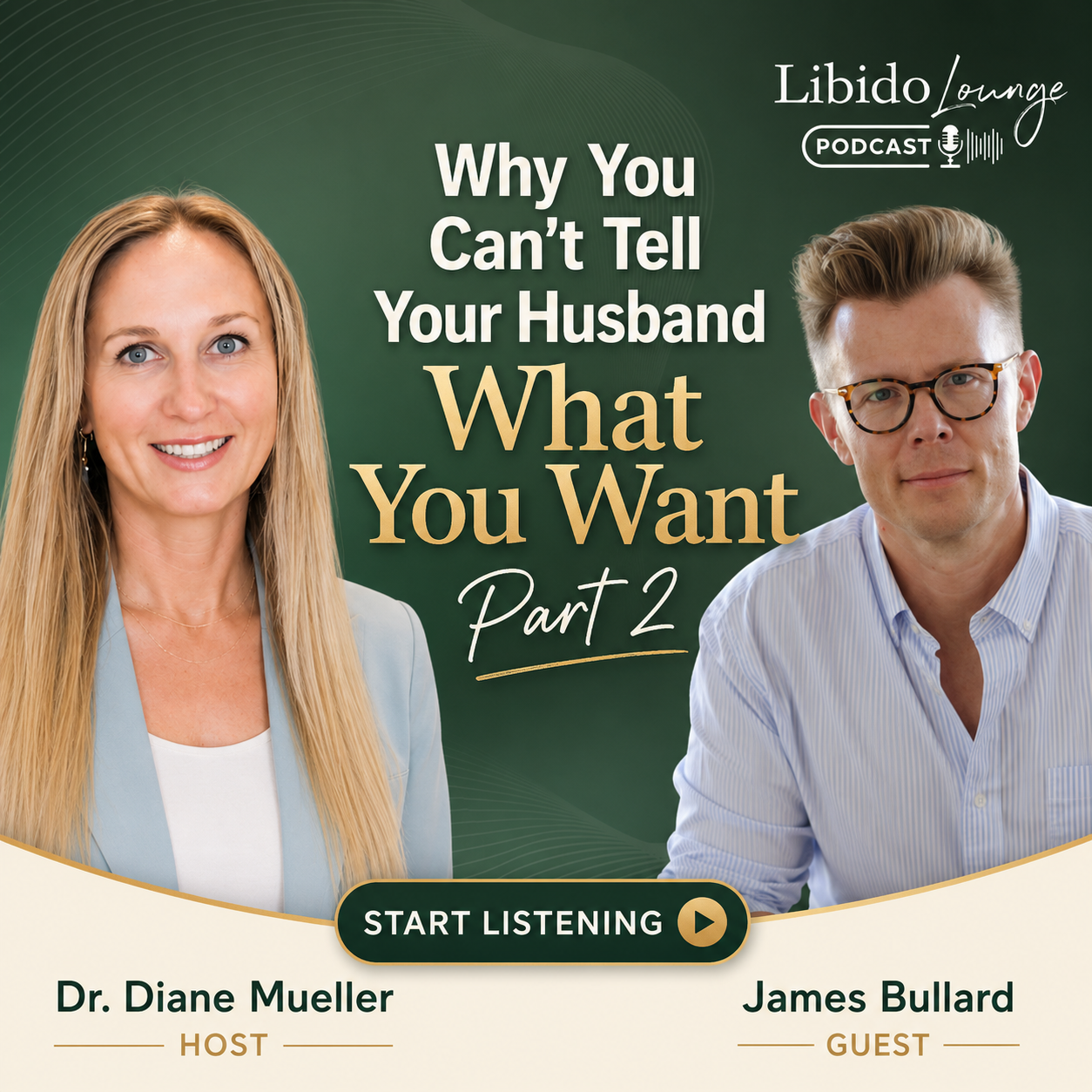
Most of us get fluent in the complaints. We can list the snoring, the timing, the old gifts, the moments that land wrong. But flipping that into a clear ask—without turning it into a fight or making our partner feel like they’ve failed—requires vulnerability most of us were never taught how to hold. In this episode, Dr. Diane Mueller sits down with James Bullard to dig into why our brains default to walls instead of gates, how to reverse-engineer desire from the things that grate, and what it actually takes to keep updating the conversation as people (and wants) change over years. They get into the difference between preference and deal-breaker, why conflict can be communication instead of combat, and the quiet cost of running an outdated version of each other.
This is a must-listen if you’ve ever swallowed a need to keep the peace—or watched desire go quiet because the words never quite landed.
About James Bullard
James Bullard is a storyteller, public speaker, and host of the podcast Radical Joy — part therapy session, part stand-up set, part permission slip to want more out of life. Through his speaking engagements and one-on-one coaching, he helps people who are secretly terrified of success as much as failure finally chase the big, scary, honest goal instead of settling for “fine.”
YouTube freebie, Sustainable Audacity: https://www.youtube.com/watch?v=F6ciBFVNjR8
Join The Bullard Brand community (includes Sustainable Audacity master class and BONUS PDF download): https://tinyurl.com/Sustainable-Audacity
Schedule a 30-minute connection session: https://calendly.com/thebullardbrand/30min
Opt-in/lead magnet: https://james-bullard.mykajabi.com/apply-to-work-with-me
Table of Contents
Why Saying Yes Feels Riskier Than Saying No: Communicating Needs in a Relationship
Dr. Diane: Communication is always such a tricky topic to try to navigate. It’s so much easier to say no because that’s a wall. Whenever you say yes and you invite something in, that is inviting the vulnerability that comes with it. There is an element of risk that can be very scary. And the human brain is wired for familiarity and safety. So what is the opposite of the thing you don’t like? Conflict is communication. It doesn’t have to be a fight.
Hi everyone, welcome back to another episode of the Libido Lounge. I have a special treat for you today because one of the things that we find so much in love, in relationships, in intimacy, and especially in our long-term relationships is that we’re creatures of habit. And so many times we go through the days, the weeks, the months, the years doing the same thing over and over again kind of on autopilot. And we become really familiar with what we don’t want, what we don’t like. And oftentimes we express these things to ourselves, to our friends, to our partner over and over again. But what’s really interesting, and this comes up a lot in how to maintain a healthy relationship, how to fall deeply in love with your partner again, and with many of the topics that come up on this show, one of the root things that we see is that it’s difficult for people to oftentimes name, even identify what they do want in their own lives, in their relationships, and more. And that’s why I invited James Bullard over at the Radical Joy podcast to come and join me today. I did a great episode with him recently and just absolutely love what he’s doing over there. So I invited him to talk to us today about a lot of things, but primarily how do we really begin to know deeply, especially when our wants change over time. How do we begin to know what we really want? Our dreams change, our desires change, and how do we begin to bring this into our relationships where we can start talking about it in a way that helps us navigate what we want and helps us in relationship get more of what we both want in a way that doesn’t make the other person feel bad or like they’re doing something wrong or that kind of thing for not giving us what we say we have wanted maybe for a long time. So James, thank you so much for being here with me today on the Lounge.
James: Absolutely. I was very excited for the opportunity, especially to cover a topic like this. This is always so fascinating to me to watch. Communication is always such a tricky topic to try to navigate. And the more we know about it and the more direct we can be with kindness and candor, I think the better off we’ll all be moving forward.
Dr. Diane: Oh, absolutely. And you know it’s a really interesting topic to get into right because I feel like, you know, it’s kind of like when in medicine one of the things that comes up in medicine is stress and cortisol and it’s like one of these things that high-level people know stress is bad, communication is good, right? So you know the idea that communication is necessary and that we need to oftentimes ask what we want—like these aren’t hard concepts but sometimes the hardest things are actually the least complicated. So tell us a little bit about your background and what made you focus so much on joy, on communication, on everything we’re going to talk about today.
James: Sure. I have a huge background in performance. I lived in New York for almost 20 years and I did a lot of performing there, touring all over the world with my band, having a really nice time with that, and we were sort of facilitators of joy. And it wasn’t just about the performance. It wasn’t just about what we could do on the stage. It was about meeting the people afterwards and finding out more about who they are and what made them tick. And the more we got to sort of connect, the more I realized like, okay, this is really something everyone could benefit from doing. So I started sort of focusing more on speaking and leadership, creativity and connection. And now I do a lot more of that in both the corporate and the personal spheres because that is something that everyone seems to want and crave so deeply. And it seems such a natural process that people don’t understand that sometimes it needs just a little bit of finesse to sort of get it to a place where it feels comfortable and healthy. And so we work on those kinds of things together so we can communicate more clearly, make those connections and make that communication more facilitating for the dynamics that we’ve built between each other whether it’s in professional or a personal basis.
How to Ask for What You Want in a Relationship When You’re Fluent in What You Don’t Want
Dr. Diane: So, with everything that you’ve studied and everything that you’ve seen on stage, offstage, let’s kind of go to the root of like why this happens. Like, why do we become so fluent in what we don’t want and not oftentimes as fluent in what we do? Like, can you kind of drop us into the why this even happens?
James: Sure. From everything that I’ve seen and everything that I’ve experienced, it’s so much easier to say no because that’s a wall. Whenever you say yes and you invite something in, that is inviting the vulnerability that comes with it. Whenever you make a border or a boundary, that protects you from whatever is on the outside of it. Whenever you express a desire, a want, a need, something that you know or are very curious to see what changes whenever you invite something new or different into that. There is an element of risk that can be very scary. And the human brain is wired for familiarity and safety. It is very much if this is not familiar, this is clearly a threat which is from thousands and thousands of years ago. We experience very, very few dangers in day-to-day life, especially when it comes to these dynamics between people, with these interpersonal moments. And so it is far easier to say, well, I don’t like that. Great. So what is it you do like? Well, I know I don’t like that. Okay, great. So, it’s a great starting point. What I do with my point of view is usually write down as many X as you could possibly imagine and then as a starting point and then our square two is we flip every single one of those 180. Okay, great. So, what is the opposite of the thing you don’t like? And so when you just start looking at the opposites of it, now that is by not even close to the final product. But what it does is it turns it on its head so you can look at it a little bit more closely, a little bit more neutrally because you haven’t told me what you’ve liked. You haven’t said what you want to try. What you said is the opposite of what you know you don’t. And so we’ve presented it in a framework that still makes it feel safe because it’s just on the other side of that coin of don’t want. It’s on the other side of a block instead of a gate that lets something in that could potentially be unfamiliar.
Relationship Communication Exercises: Flipping “I Don’t Like” into Clearer Wants
Dr. Diane: Okay, so let’s break this down a little bit more. So if I’m with my partner, right? Or if anybody’s with their partner and they’re going to do this exercise and they’re going to say, okay, well, when it comes to their relationship, what do they not like? And maybe they don’t like that their partner snores or maybe they don’t like that their partner wakes up so early or stays up so late or maybe they don’t like that their partner chews with their mouth open or whatever it is, right? So they write down their I don’t likes and then so are you saying like let’s say if it’s like oh I don’t like that my partner snores then in the like quadrant then they would write what?
James: I like sleeping without snoring. I love sleeping without snoring. I like my partner when he uses a CPAP, when he puts one of those clips on his nose to make sure that he gets enough air coming through his passageways. I like occasionally asking him to sleep on the sofa or I sleep on the sofa. It’s finding the point where we can all be okay with it because this is not something that you can bring up to someone because you’re afraid of hurting feelings, you’re afraid of crossing a boundary, or you’re afraid of asking something of someone that is simply not possible. Snoring is one of those things where this is a deeper issue. This is a physiological something. This could be apnea. This could be a condition. And that’s not something that’s like a habit. It’s something that is part of your partner. And you have to find a way to either move past it or figure out what it is in the realm of compromise that we can both reach.
Expressing Needs Without Conflict: Preference vs. Deal-Breaker
Dr. Diane: So then what I hear you saying—and stop me if I’m wrong here—is that are you differentiating the word like from the word want? Where it’s like, okay, if you were saying something like, well, I like my partner when he sleeps on the couch sometimes or she sleeps on the couch sometimes in that scenario, are we saying that’s different than want? And then we would take it a step further or where are we getting into the want? Can you walk us through?
James: I think we can literally walk it through every single one of these steps. What is a deal breaker? What is a preference? What is this thing that’s just annoying just because I’ve had too much coffee today and it just—I want to throw him into traffic? You have to make these levels and discernments because some of these things you’re just like, if you do this one more time, this is going to be a situation where we’re going to have to have a very serious conversation, one I don’t want to have, but it has gotten to a point where I simply cannot deal with it anymore. Snoring is one of those things. Yeah, it’s not pleasant, but there are so many solutions for that. Whether it’s an appliance or an apparatus or somebody wears earplugs or somebody—you get a bigger bed, you get a better mattress or a different like pillow. There are solutions here. It’s not a deal breaker until this is something that has no path forward. Great. There are so many things we can try with this. We can speak to professionals. We can talk to medical. Like there are a million ways that we can do it. Snoring is a great example because there are a million ways that you can approach that. That is a river that has a million ways over, across, around, and through. Something that is like, I don’t love it when you say disrespectful things to me in public. I don’t like it whenever you come home with something for me that is the same gift you’ve gotten me for the last 15 years for an anniversary or a birthday. I don’t like that you’re not a babysitter for the child. You are a parent. This is the kind of thing that comes across as a very specific and needs a very direct line of communication because this is conflict is communication. It doesn’t have to be a fight. It just needs to be one of these things like this is a non-negotiable. I have reached a point where I can no longer stomach this and I need us to talk about this as two adults who want to find a solution that is equitable for all and that we can all benefit from something different happening.
Vulnerability and Communication in Relationships: Why Most People Never Analyze What They Want
Dr. Diane: So, one of the things when we were talking a little bit and emailing back and forth offline that you had mentioned was that most people spend absolutely no time analyzing what they want out of a relationship. And that really hit me just because of how right on I think that is. It’s so easy that we just like go into relationships and sometimes in relationships like coaching and these sorts of things, it’s talked about like high level like okay, make sure you have value alignments, right? Make sure that you want kids or you both don’t want kids and you know so there’s like things that are talked about like high level. And I think in a fairly good amount of people if they’re lucky they at least talk through some of these things. Do we want kids? Do we not want kids? Do we want to live by the beach? Do we want to live by the mountains? And then other times, I’m sure that’s not even discussed at all. So, what I’m hearing and what you’re saying is a lot of this is talking like much more micro than people actually probably ever get into before and during their relationship about what they actually want out of the relationship. So, is this how people do that? Is this how they analyze their relationship? Are there other steps? Are we starting at the right point? Is that really the first step is like name what you don’t want and then go from there.
I want to take a quick break from my episode to say sometimes a simple trial of something novel goes haywire and can send havoc through the sexual relationship. It’s really common to try things such as talking about a new sex toy or a new position or maybe even just talking about the fact that you haven’t done it in a while that you want something new. Maybe there’s erectile dysfunction to work with. Maybe there’s vaginal dryness to work with or pelvic pain and you have that conversation and it doesn’t go well. Many times when this happens, there’s a sense of break in the relationship where it gets shoved under the rug never to talk about again. This is one of many examples of what we explore in my Hot Monogamy Society. How to bring these conversations to the table so that it puts you back on the same team again, helps you bring passion back and helps you ultimately solve the sexual imbalance or discrepancy or desire mismatch whatever it is so that you can be back on the same team with your passion and your sexual and relationship life. This is the only doctor-led science-backed program like this of its kind. I hope you will join me in the Hot Monogamy Society. See the link in the show notes of how to get started. Now, let’s get back to our show.
James: I don’t think it’s a first step. Honestly, I think that and whenever we begin relationships is very much a primal to the situation. We find each other attractive. Enough of our shared values match. This is great. Moving forward, we will continue to explore this and we will decide together how deeply we want to take it, how seriously I am in this for this goal. And I think that being very truthful in those questions is important as long as you are understanding on both sides that this is truthful for me right now as I see it. I think a lot of people are looking for an absolute truth from someone right away whenever there is still very much an elasticity to it where this is how I feel right now and I really honestly believe that what I’m telling you is the truth and the more we get to know one another and the deeper we go into this that will continue to evolve and I think flexibility on both sides of that partnership are very—that’s a very important thing to carry with you. It’s not that someone told you a story. It’s not that someone wasn’t being entirely truthful. They were telling you the truth as they saw it at that moment in the relationship. And that will continue to grow and need space and grace as both of you learn more about each other and what you do and don’t want from that very specific dynamic.
How to Talk to Your Partner About What You Need as People and Desires Change
Dr. Diane: I think it’s a really important thing that you name. And I’m even going back in my own mind as you say that to a relationship in my 20s where a boyfriend was frustrated with me because I had changed my mind about something, right? But this was—it was like the verbiage you’re using is so perfect because to him he was frustrated because he felt like I misled him. And to me it was exactly what you were saying. It was like what I said was very true in that moment and now time has gone by and this is also very true in this moment. And I think it’s one of these things where and especially in long-term relationships, we can get into this point where we just—we stop asking questions and we stop sharing because we just feel like well, we’ve asked that question already and we should just know versus there’s so much richness that I think can come with these long—you know longevity of relationships if we are coming back and saying like oh the you that I knew five or 10 years ago, sometimes even one week ago is not the same you as is here today, right? That’s largely what we’re saying is that we have to have a process for going back and reasking these questions over time.
James: Yes. And being solid enough in the relationship at any given moment to understand that when you ask that question again, it’s not an accusation. It’s not a gotcha or an aha moment of any kind. It is making sure that we’re still on the page I think we’re on. This is what I have in my mind. Is this where you are? There is no wrong answer. I just am operating on what I think I remember from when we had this conversation before. And if this has changed because the situation has changed, we’ve grown. We’ve changed as people together as well as individuals. Is that still where we are? Because a lot of times that can feel very abrasive. It can feel as though you’re in a spotlight in the interrogation room and that’s not it at all if you’re in a healthy, loving, caring, kind relationship. It’s just trying to make sure that if something has changed that I continue to stay current so I don’t find myself in a place where I’m operating on an old OS. What I want to be is up to date so that I can continue making inferences and whenever things get a little friction, if I notice that, I can ask it without fear of upset or anger or a night on the sofa that has nothing to do with snoring.
Practical Ways to Check In: Questions, Timing, and Staying Curious
Dr. Diane: So I’m curious then when it comes to kind of the practicality of this and I understand some of the methodologies you shared and I know you have a whole process that is a much longer process than we can cover on the show today to really take people through. But I am curious like do you have like a set of questions for example that you recommend people asking each other and asking themselves around these things? What do they want? What do they not want? And obviously, like you said, people tend to know what they don’t want. So, that one’s pretty easy. But I’m wondering if there’s a list of questions, and if so, also, how often in relationship do you recommend that people come back to checking in with each other on these types of things?
James: I love to enter into a relationship with a lot of lightness, a lot of humor because at the beginning it’s all like fun and so exciting and all these kind of things and you want to keep that emotion level high, very positive, very light, very shiny. As that continues, you get deeper and it becomes richer. It doesn’t become darker. It just becomes richer with other inflections of the relationship and you continue to start deepening your questions as well. At first, it’s like, you know, what’s your star sign? and what do you love to do on a date? And then it becomes things like children or religion or political leanings or these kind of things. Like in a relationship it’s so important to know these kinds of things because when you ask the question how that person answers the question is almost as important as the content. You know, if you’re getting close to something sensitive or tender, you need to make sure that you continue fostering the sense of safety in the space so that they don’t feel tentative about sharing those kinds of things with you. You also need to check in on yourself to see how you’re responding to their both their attitude and the content of their answers. Is this something that puts me off? Is this something that makes me feel a very specific kind of way? Instead of judging it, being curious about it, why do I feel like that? Why am I having this moment about it? And as that continues to deepen in the relationship, it’s no longer an internal question that you ask yourself, but you can discuss that with your partner and further enrich that bond because this is the thought. This is the question that comes in my mind when you say that and how you say that. And I am trusting you with a lot of vulnerability right now because this is my entire process. Are you okay with that? Should I keep this to myself? I want to share that with you because I think it’s important that you know exactly where I am when you say these kinds of things and how you respond. Is that okay? You continue to check in. It feels tedious. It feels repetitive. It feels untrusting. And to me, I would argue that perhaps it is exactly the opposite because at every moment you give them an opportunity to respond candidly to your process of what it is they’re saying to you and how much importance you put on what they’re saying. It really is a compliment to wanting to know more instead of just going through the motions. These are the questions I ask. This is why. This is what I’m thinking. This is what I’m feeling. This is how I’m processing it. And I’m going to go back and journal about one, two, three points later. Cool.
What’s Coming in Part 2 + Resources for Clearer Communication
Dr. Diane: Okay, great. So, my follow-up question is, and this is a follow-up question for the next episode. So everybody, we are going to continue this conversation with James here in part two. And my follow-up question though that you will hear in the next episode is this is what if we are asking our partner—like a lot of what I’m hearing what you’re saying is almost like asking permission like is it okay if I share this? Is it okay if we talk about this? And my curiosity is how do we respond with your methodology if our partner is like no that’s not okay and what do we do to navigate that? So, we’re going to talk about that in the next episode. I’m also going to ask James a lot about how his methodology applies to things like desire mismatch, communication gaps, and a whole lot more. So, we’re going to get into a little bit more in the intimate space here in episode number two. So, make sure you do subscribe in order to get that. But before we go, James does have a free gift for you all. He also has ways of working with him and supporting your communication, your desire, your ability to communicate and ask for what you want and talk about this—all of that and more. So, we’re going to let James talk about that. But if you would, James, first tell us a little bit about Sustainable Audacity and your freebie where people really are supported with helping to change their current system as we adapt and change and we find that I have a new dream. I have a new desire and the current way, the current mode I’m in is maybe not working towards that anymore. Tell us about that if you would.
James: Of course. Sustainable Audacity is literally just 20 minutes where we discuss about walking into a room, owning it, being who you are, fully embracing it. You get into the room and you’re not going to be everyone’s flavor. That’s really the long and the short of it, and that is absolutely fine. The more specific you are, the more likely you are to draw those to you who have a very similar color and frequency. And if you rub someone the wrong way, if for whatever reason you aren’t going to jive, they will know that right away as well. And you can avoid wasting any time trying to make a connection with someone who doesn’t necessarily feel that initially. It’s so important to make a great first impression. It’s also really good to know your people. Not trying to chase anyone away, just making sure that your vibe is specific enough so that if they’re not sure it’s a match, you can connect with your closest the most quickly. It’s literally 20 minutes of us just talking about what that means, what it is you want out of your life. People don’t follow up with themselves enough. They may be operating on a dream that they had when they were in college and now they’re 20 years later and they’re still chasing this and they were like, why am I not more successful about it? And it’s like, well, maybe you’re not successful because your idea of success doesn’t match the dream that you made 20 years ago. So, we take a very close look at that and we look at where you are in your life, what your dreams are now, goals. We set up a desire scheme as well as systems in place and small disciplines, small consistent steps to move you closer to that to make sure that your daily actions are aligned with it. If not completely running toward it. At least they’re going parallel so that you continue to move in that direction so that you feel more productive while you’re moving toward this new dream that is more aligned with who you are today than whenever you first made it when God was a child.
Dr. Diane: Yeah, I love it. I love it. And I think there’s so much to be said there about just like the confidence and I—a lot of what I hear and what you’re saying is also efficiency, right? Which is one of my core values around my—and I think it’s so many of our core values because time is really precious. It’s like none of us get it back. The time goes so fast. So there’s a way to walk into the room and attract those who are your buddies, your—you know your people and really know like oh yeah these—this is my tribe over here and these other people are—you know maybe wonderful humans but are just not my tribe. That’s a really great and efficient skill to be able to hone in on that and to tailor that and uplevel your game with that. So amazing. And that will be in the show notes everybody—the freebie on that. And then you also do coaching programs and that sort of thing too, right James?
James: Yes. That’s what the Sustainable Audacity leads into another course. If what you see in that 20-minute freebie is something that you think you could love to nurture with someone, accountability is so important. And I am an aggressive cheerleader. I have a soul X-ray superpower. I see through folks to know what it is that they’re really trying to do with their lives. I would be more humble about it if I hadn’t done it a million times already. People come to me saying a problem and we talk about it and I was like, well, what I’m hearing is this. Have you ever thought of exploring this? Not ignoring the initial problem that they brought, but also adding this as a supplement. This is the part that we could also work on side by side in tandem. It’s sort of the side car to your main cycle and we’ll get to the center of it and figure out a way so that all of these things can be addressed in short order. Like you said, efficiency is so important because ain’t nobody got the extra time to be spending too much on this. We get to the crux of it. We figure it out and we make small consistent steps so that you can get to where you’re going.
Dr. Diane: Beautiful. So, that’s a wrap everybody. Please do look in the show notes for James’ freebie, how to work with him, and more. Please also look for how you find the next episode, which because this episode’s coming out first, the way to find the next episode is to make sure you are subscribed to the channel. Remember, we’re going into desire mismatch. We’re going to talk about if you do a bid towards your partner and your partner doesn’t respond to that bid and you say, I want to share and your partner’s like, I don’t really want to hear that. How to respond, what to do, how to take care of yourself, how to take care of the relationship, and so much more. So, make sure you subscribe, download James’ freebie, and we will see you all again in another episode of The Lounge. Thank you, James, for being here with us.
James: Thank you, Dr. Diane.
Dr. Diane: Thank you for listening to the Libido Lounge. Please don’t keep me a secret. Please share this with your friends. You can find me on YouTube, on Instagram, and check out our Modern Libido Club for so much more!

Want Part TWO of this Episode?
Each podcast interview includes Part ONE of the interview.
Join the Libido Club to unlock the complete conversation.
Our Advocacy:
Our advocacy is centered around providing a supportive space for women to reclaim sexual vitality and joy for good. Help us achieve this by subscribing to our podcast and sharing us with your friends and family.
 Ready for a Hot and More Modern Version of Monogamy?
Join the Club: https://mylibidodoc.com/club
Access Lab Testing: https://platinumself.circle.so/c/community
More Libido Lounge
 Website | mylibidodoc.com/podcasts/
YouTube | youtube.com/@mylibidodoc
Instagram |https://www.instagram.com/myromancedoc/
Facebook | https://www.facebook.com/myromancedoc
Health Store | https://store.mylibidodoc.com/